



The New York Post arrives in the morning like a brick through your window. It does not pretend to be above ideology. Its newsroom consists of eccentric conservatives, outer-borough uncles, Staten Island monarchists, Midtown libertarians, and the occasional tabloid surrealist who seems to have wandered in from the 80s. The Post is biased the way a cartoon is biased: the headline is the argument; the argument is the punchline; and the punchline is — occasionally, disconcertingly — perfect. Especially when its target is New York Mayor Zohran Mamdani, who celebrates his 100th day in office today.
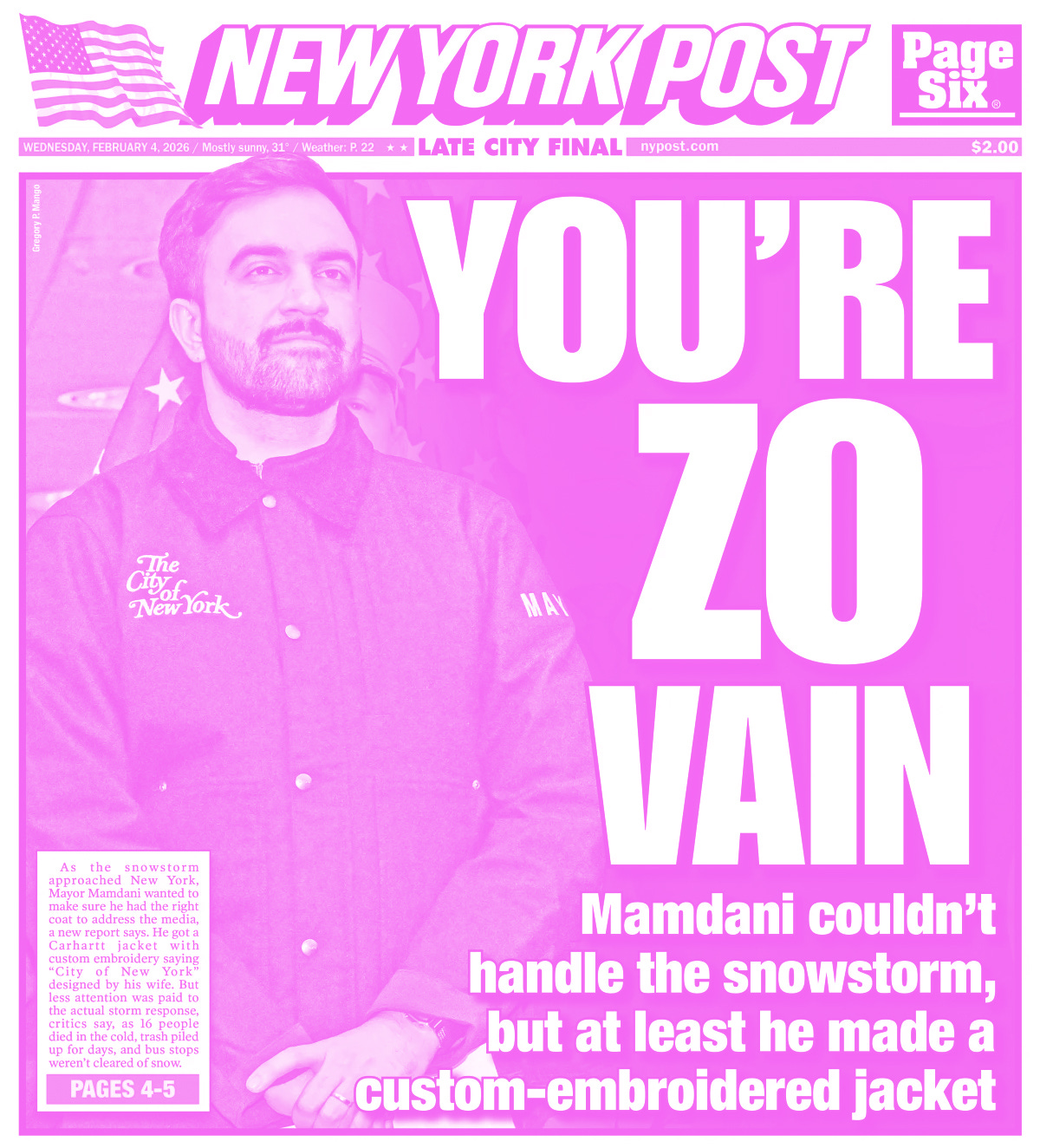
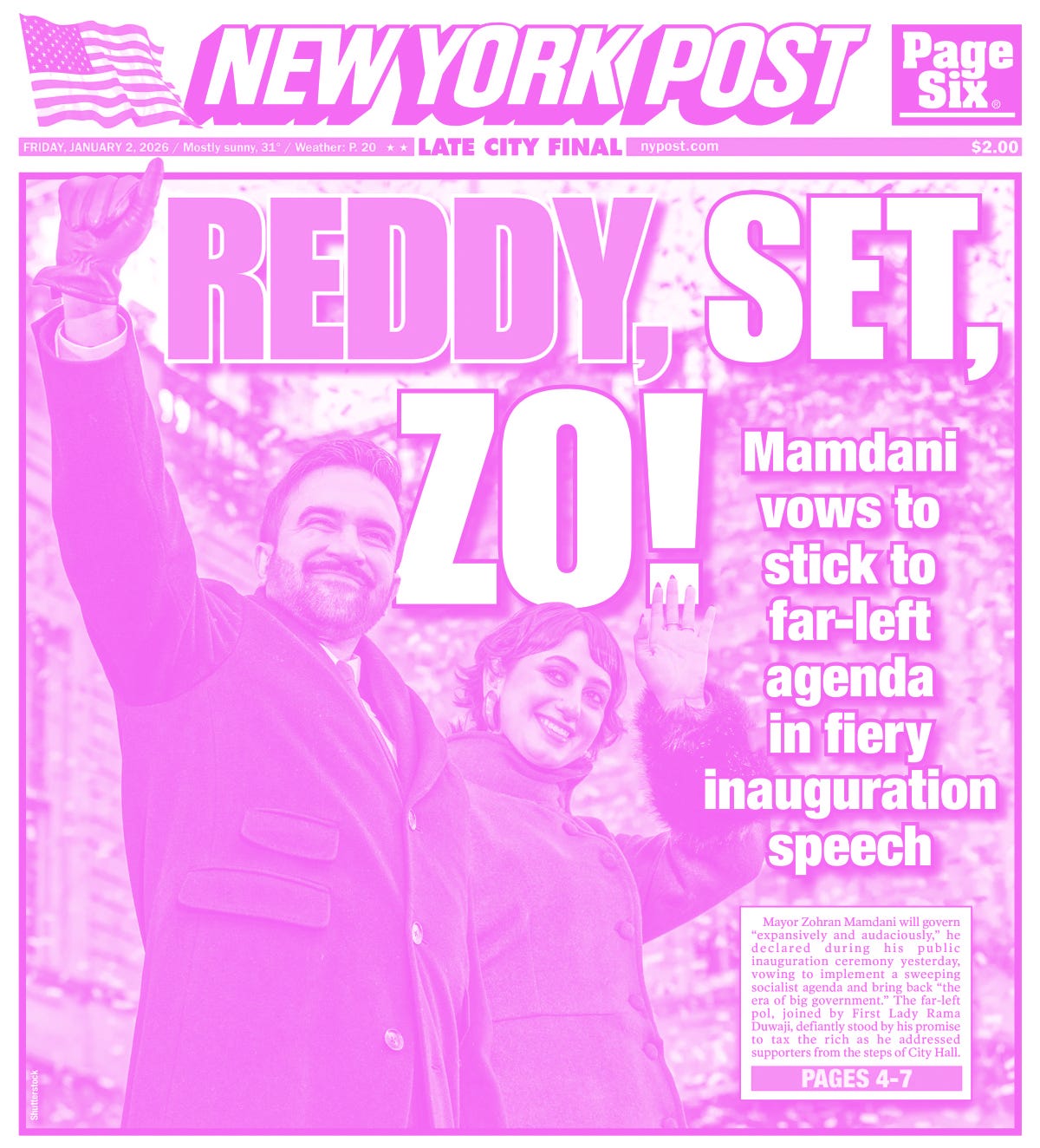
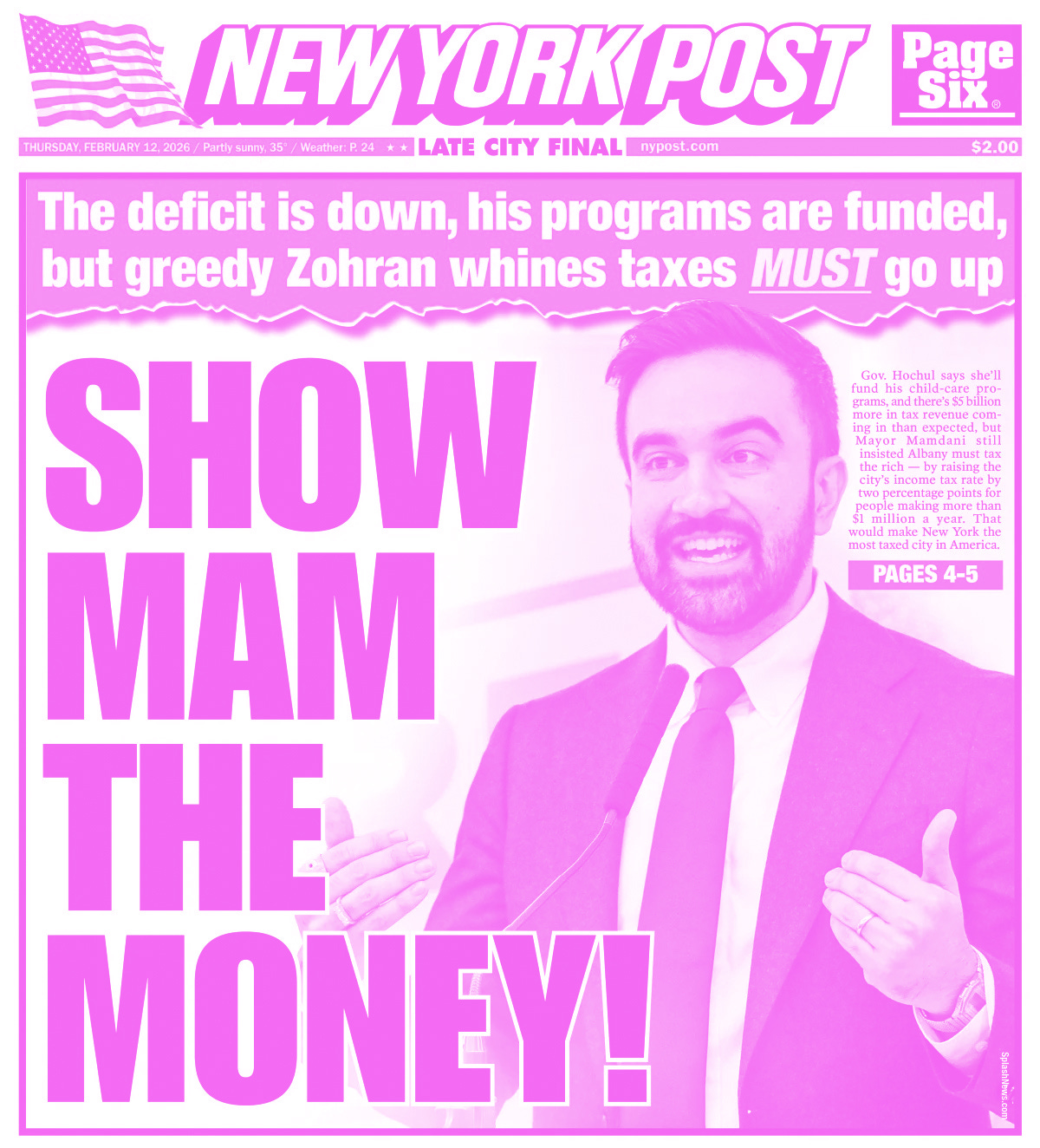
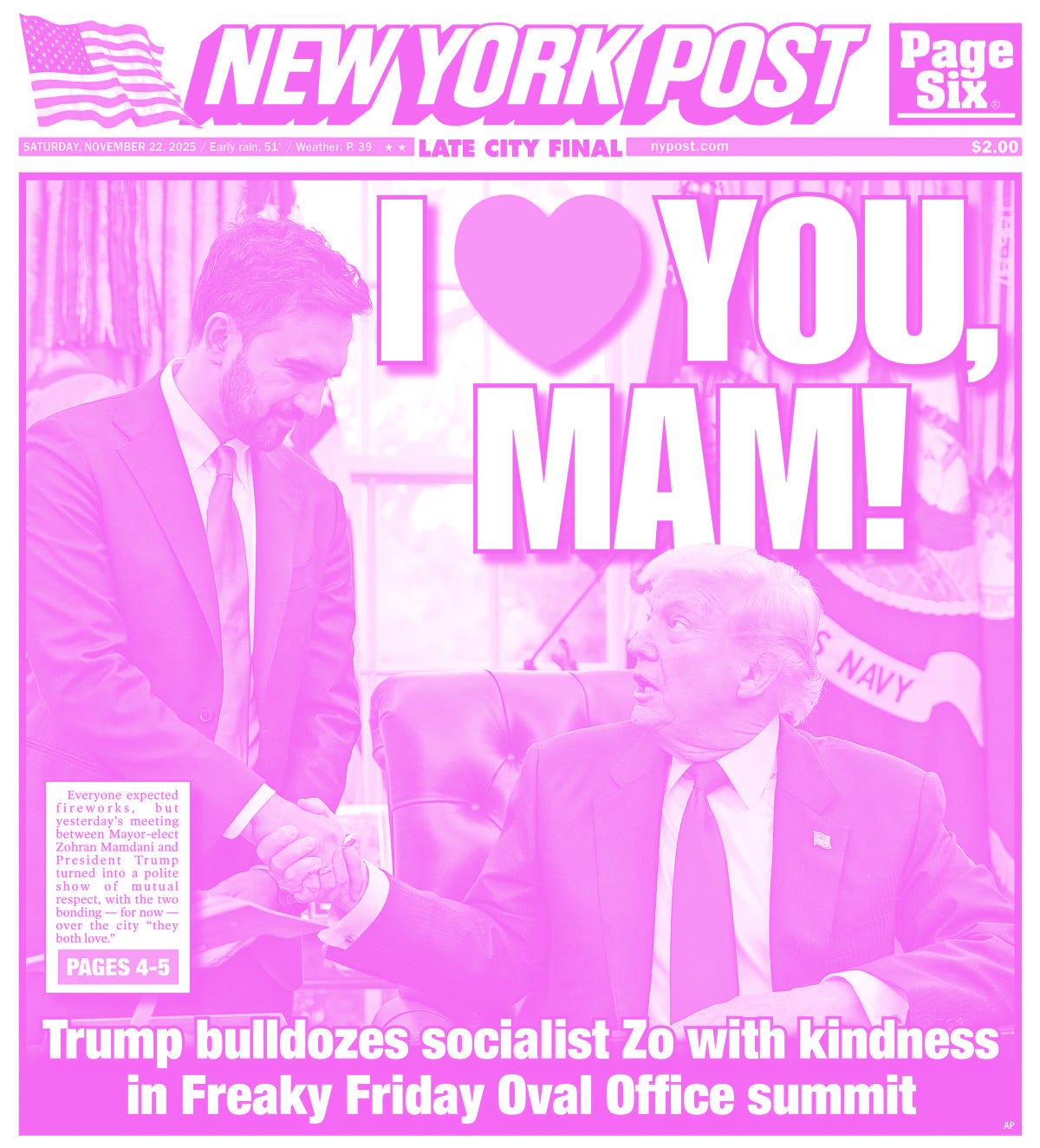
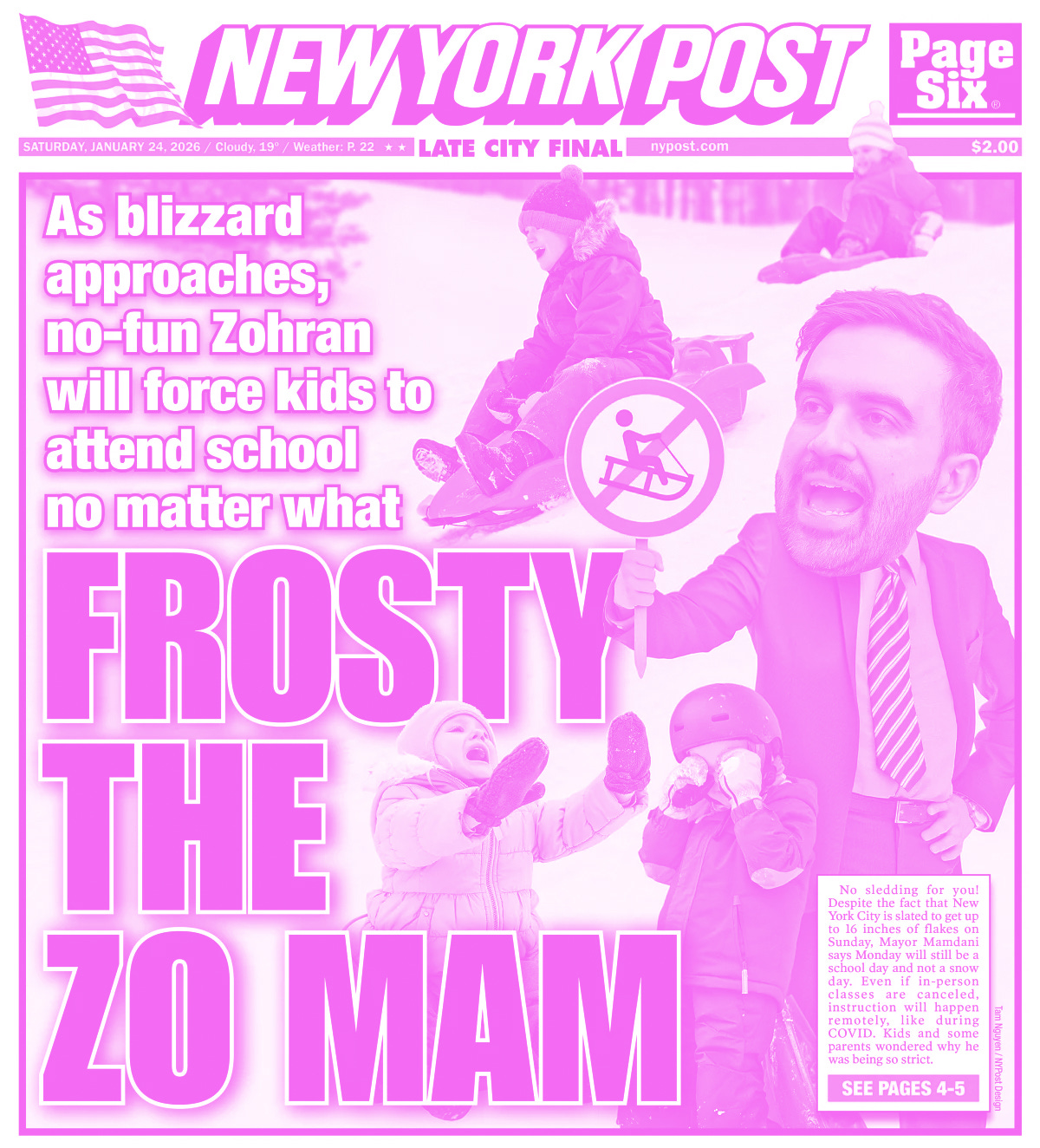
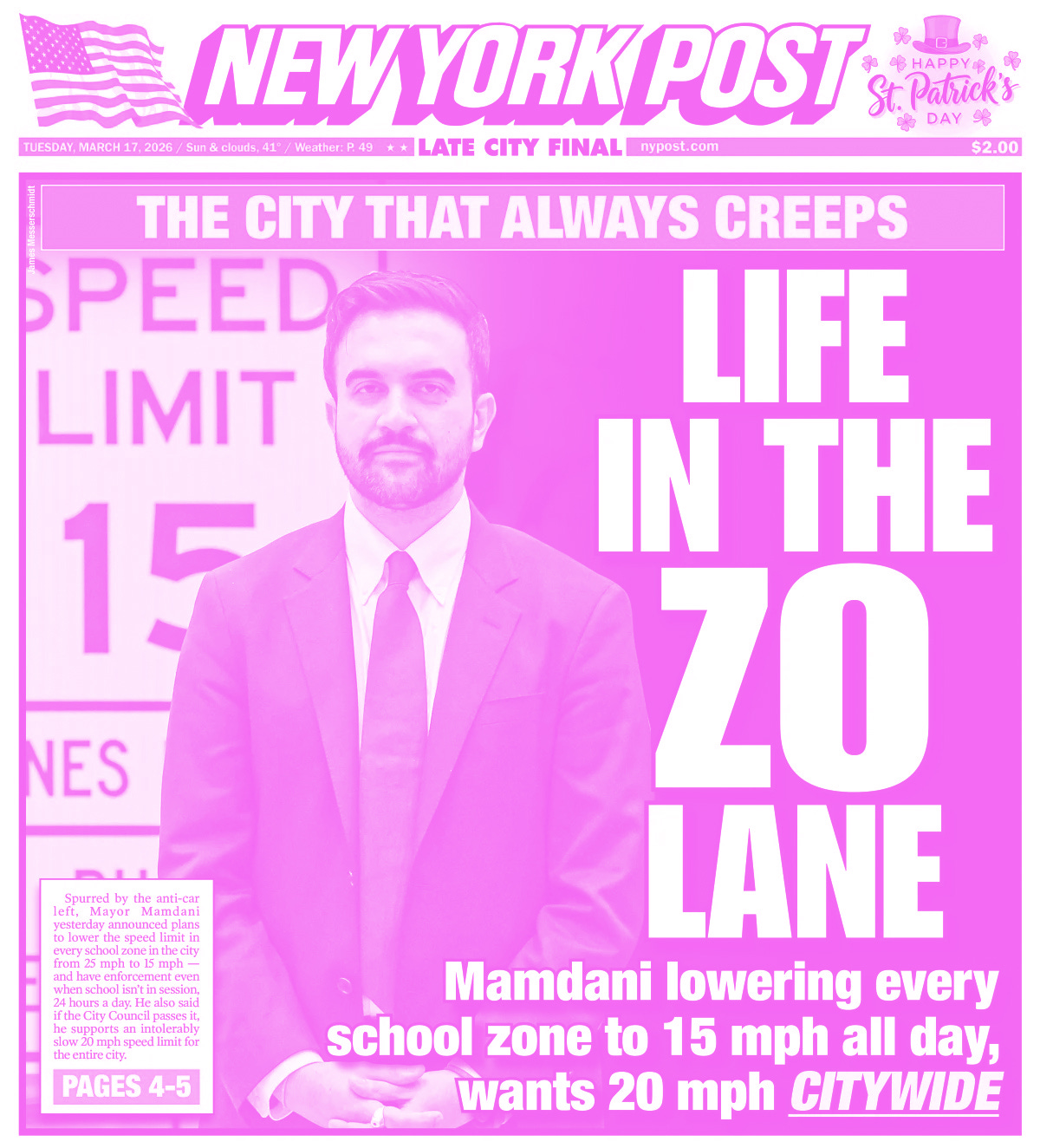
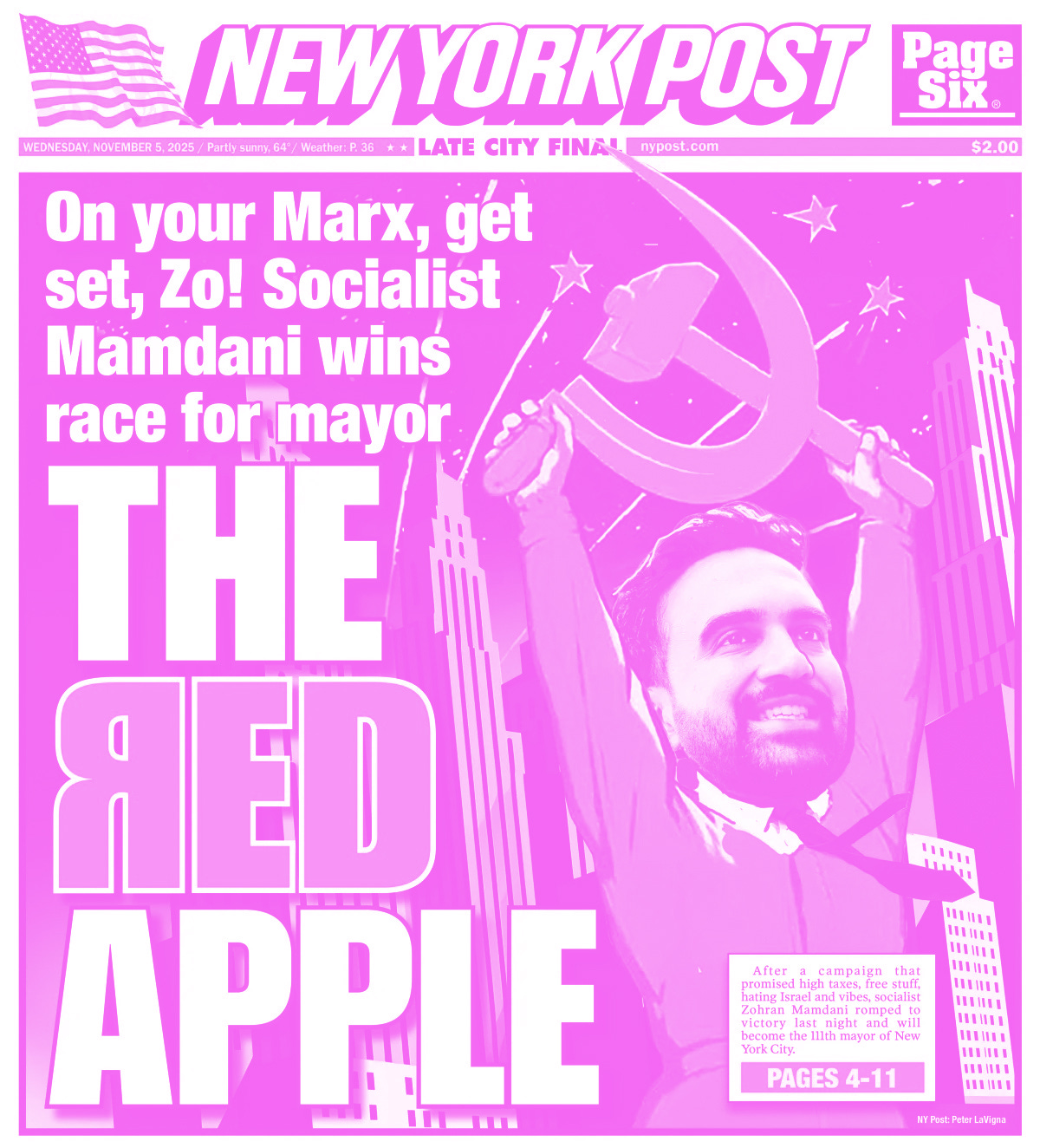
Since Mamdani’s election in November, which it marked with a headline that began “ON YOUR MARX, GET SET, ZO!” set against a cheekily dystopian evocation of “THE RED APPLE,” the Post has been doing its level best to lambaste the city’s first mayor from the Democratic Socialists of America. (“YOU’RE ZO VAIN,” “DO AS I CHE,” “FROSTY THE ZO MAM,” “SHOW MAM THE MONEY!”) They have depicted him, variously, as a Wild West gunslinger whose six-guns shoot Soviet flags, a colossal King Kong–sized man with a tiny head, and Chairman Mao. The gestalt is ostensibly contemptuous. And yet one can’t help but notice how much fun the paper’s writers are having these days, the delight they take in their work.
It is, you might say, a return to form. It’s been a lean couple of decades for the New York Post, which put the BLOID in tabloid back in the 1970s and 80s, when the titular city suffered through fiscal ruin, blackout looting, gang wars, crime waves, and serial killers, overseen by a Democratic political machine that was somehow equal parts exhausted and hammy. This was the golden age of Post headlines, telegraphic bursts that epitomized the crisis, rhetorically staged as a daily farce. It was an era of extremity that demanded extremity in return; catastrophe was the layout. (“HEADLESS BODY IN TOPLESS BAR,” “GRANNY EXECUTED IN HER PINK PAJAMAS.”) This marriage of wit and whimsy, malice and aforethought, was one of the innovations of Rupert Murdoch, who jumpstarted his march to American media moguldom by purchasing the Post in January 1977. An entire chapter of Paper of Wreckage, the distressingly engaging oral history of the tabloid, is devoted to the headlines.
But somewhere along the way, the paper’s insouciant sensationalism got lost. (Twenty years of Republican governance didn’t help.) The election of Rudy Giuliani as mayor in 1993 was a watershed moment: Giuliani was the apotheosis of the Post’s worldview, its politics given corporeal form. There was nothing left to caricature. His successor, Michael Bloomberg, was too insulated by wealth to be entertaining, while Bill de Blasio, the first Democratic mayor of the 21st Century, evinced a diffident lameness unworthy of ridicule. It took Eric Adams — the ex-cop egomaniacal vegetarian dandy — to rekindle the paper’s dormant instincts. (“RAT-OBSESSED ERIC ADAMS CREATES NYC ‘OFFICE OF RODENT MITIGATION’,” “ERIC ADAMS CELEBRATES HIMSELF… WITH TIME CAPSULE”)
And now, with Zohran Mamdani, there is a sense of anticipation, even glee, at the return of a worthy antagonist. Mayor Mamdani is earnest and disciplined, fluent in a language of solidarity that feels imported from another, more optimistic era. (A vastly more literate era: in his Saint Patrick’s Day message, Mamdani cited Ireland’s history as England’s first colony, name-checked IRA hunger strikers, and eulogized the gay Irish nationalist and human rights campaigner Roger Casement (d. 1916), while thanking the Irish people for supporting the anti-apartheid struggle in the 1980s and Palestine liberation today.) The mayor has a gift for moral clarity, invoking housing justice, the public good, and all manner of collective flourishing. He does so without irony — he can be cheerily, unabashedly cringe — and the Post is both unmoored and invigorated by this.
Perhaps it’s no surprise that the Post is itself having a renaissance — and that this renewed relevance comes at the expense of its debonaire cousin, the New York Times. The Times, which has become expert in recent years at both-sidesing the apocalypse, is put off by the Muslim mayor. Climate collapse is imminent, but so too are the concerns of hedge fund managers; police misconduct is troubling, but we must know where boat owners buy their watches. Thomas Friedman and David French bloviate unabated. The Times feigns disinterest. It contextualizes and historicizes him, frames his proposals as emblematic of a generational drift. It asks whether he can “build a coalition” and “thread the needle.” These are not hostile questions; they are quietly oppositional. They entertain the legitimacy of his worldview and then debate its feasibility with a prefigured answer (the answer being: “probably not” or “please God, an au pair does not a tax require”). The only thing they can manage to do, with any verve, is talk about the nicknames other publications give the mayor. Meanwhile, when the Post paints Zohran as the avatar of a socialist fever dream, it’s screaming what the Times not-so-secretly believes to be true. Through insane rhetoric, the Post demands he account for the anxiety he inspires. The paper’s readership feels that something has run amok; the old New York is dying. Why not express that feeling in a 144pt yawp? “SAY IT AIN’T ZO!”
To be clear: the Post is not noble. It is ugly, with a long and storied history of xenophobia and a fetish for law-and-order. Its “reporting” bends ineluctably toward capital, toward punitive policing, toward a nostalgia for a New York that never existed. Read it with suspicion. But read it. In the Post, one can encounter journalism in one of its rarified and useful forms: adversarial, unapologetic, caustic. The paper does not conceal its thumb on the scale: it is all thumbs. There’s something almost refreshing about that in an era when institutional objectivity has curdled into affectless equivocation. The Post is not neutral. It picks a side, blows the (apocalyptic) trumpet, and invites you to come hang out.
During the campaign, Zohran liked to quote an adage of his father’s about moral victories: “When the Right gains power, the Left writes a great book.” (In fact, his father, the African political scientist Mahmood Mamdani, has written a number of such books.) If the obverse is true, and Zohran’s mayoralty is symbolic of the Left gaining power, perhaps the New York Post, with its eccentric animus, is spitballing ideas for what may one day become the Right’s great book?