

Reading After Persepolis
On Marjane Satrapi (1969-2026)


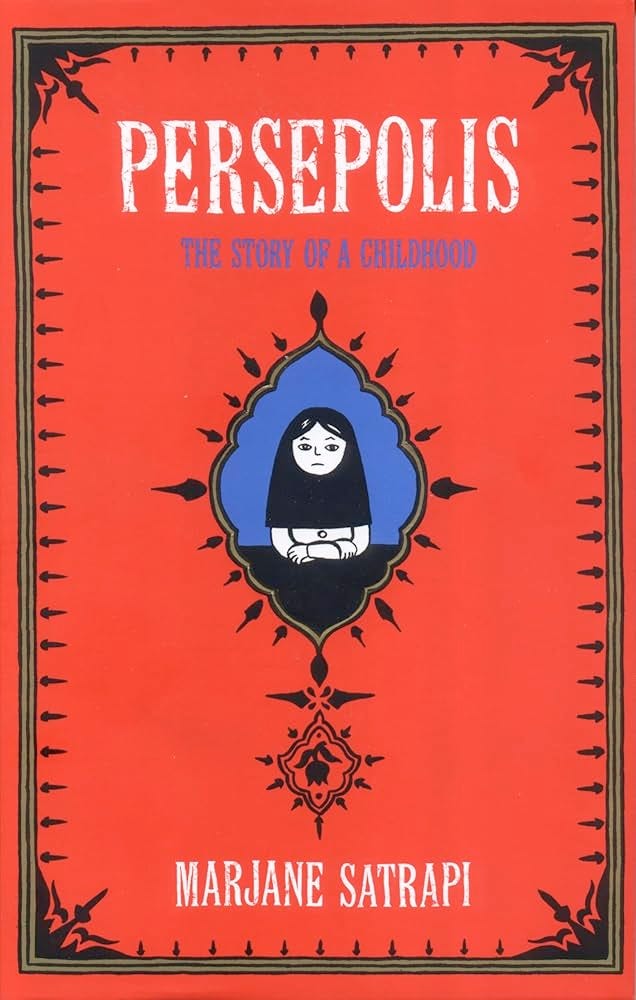
In 2000, in Paris, the artist Marjane Satrapi published the first installment of Persepolis, a memoir of her Iranian childhood before and after the 1979 Revolution, told in the form of a black-and-white comic book. With the wide release of an English-language translation four years later, Satrapi received rapturous praise for her simple yet elegant artwork and sharp yet self-deprecating humor, even while telling harrowing tales. A 2007 animated film of Persepolis cemented the book’s reputation.
When news spread earlier this month that Satrapi had passed away at the age of 56, tributes poured in from across the globe. There were critiques, too. When we asked the scholar Naghmeh Sohrabi, author-convenor of the invaluable newsletter These Are the True Things, for her thoughts, she described the conflicted mix of misgiving and admiration that Persepolis provoked when she first read it, decades ago — a “shock of recognition along with an uncomfortable feeling of being misrepresented.” (Like Satrapi, Sohrabi came of age in 1980s Iran, during the 1979 revolution and the Iran-Iraq war that followed.) This week at A Protest Against Spaghetti, we’re delighted to publish her reflections on Satrapi’s defining work and its complicated legacies.
Sometime in late 2003 or early 2004, I received a copy of Persepolis: The Story of a Childhood, a recently published graphic novel, signed by Marjane Satrapi, the author. It was a gift from someone I was dating at the time. He’d stood in line at one of her book signings and asked her to inscribe it to me in Persian. “She hoped she got your name right,” he said. I remember lingering on the bright red cover, unsure why he thought I would want to read a comic book besides the fact that both Satrapi and I were born in Iran. When I looked closer, my heart sank. Beneath the stylized white and blue title was a drawing of a girl wearing a black maqnaeh, the headcover required in the 1980s for schools and other official spaces in Iran, her arms folded, staring unsmilingly at me. I knew that face: It was me. Someone, I thought, before I even opened the book, had written my story.
For years my father had insisted that I write about growing up in Iran during the eight-year war with Iraq, and for years I had found other things to do. But here was Marjane Satrapi — two years older than me, cooler than me by any available measure, with her cigarette and her Paris and her cute mole on her nose — who had done exactly what my father had suggested. Oh well, I thought, I missed my window. Then I saw the title of the first chapter, “The Veil,” and groaned. Here we go again: Iran, women, veil. That tired trope.
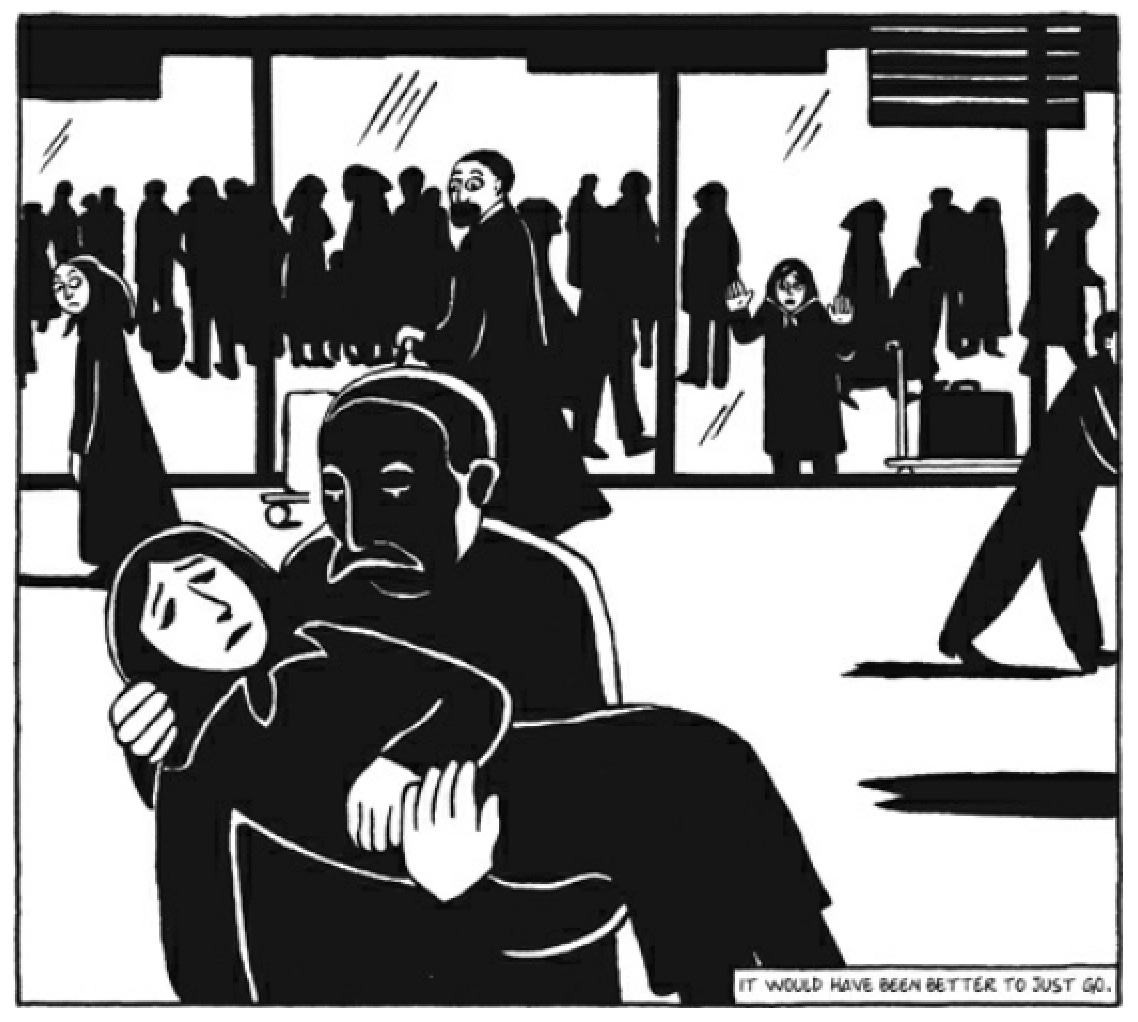
Still, I didn’t stop reading. I couldn’t stop. By the time I got to the book’s devastating final panel — Marji’s father carrying her mother’s limp body out of the airport as young Marji, the precocious narrator of Persepolis, watches from the other side of the glass divider as she’s about to depart alone for Europe — I was all kinds of confused. I felt seen and at the same time betrayed. I couldn’t sort out why, exactly. I needed time to better understand my feelings. But time was not on my side. Soon after Persepolis exploded onto the American literary scene, another book by another Iranian woman arrived in bookstores, and for the next few years it was all anyone wanted to talk about.
That book was Reading Lolita in Tehran, Azar Nafisi’s memoir of a reading group that met in her home in 1990s Iran, where she and seven of her former female students read classics of English language literature. The cover featured a photograph of two girls in maqnaehs, their eyes looking down, ostensibly reading — which is to say, not staring back at you, grumpily. Four paragraphs in, I groaned again as the veil arrived, like catnip for the reader, establishing this text, like Persepolis, as the tale of a daring antagonist in a battle with a draconian state.
By the time I got to the scene of Nafisi taking a shower and narrating her thoughts as “the water caressed my neck, my back, my legs,” I had a headache. It wasn’t just that everything she was saying felt untrue. (As a bilingual kid in post-revolutionary Iran who read a ton of books in English in public, I was puzzled, to put it generously, as to where the danger and/or the bravery in discussing books in English lay.) It was also the writing. I felt like I was being hit on the head with a plastic mallet every time I turned the page. I did not finish the book.
For years afterward, I found myself frequently conscripted into the same conversation: “I loved Reading Lolita in Tehran/Persepolis. Did you?” This prompt arrived not just from colleagues and faculty of every nationality, discipline, expertise, and gender, but literally everywhere. Waiting in line with a friend outside a restaurant, a woman, realizing we were Iranian, interrupted our conversation to share that she’d just finished Reading Lolita in Tehran. “Iranian women are so brave,” she confided.
But although both books had been swallowed whole by a Western readership hungry for a particular Iran — veiled, oppressed, and easy to digest — and both had made that readership feel informed yet safely sorrowful, Persepolis was different. The most obvious difference lay in the fact that Marjane Satrapi was, undeniably, an artist. In creating Persepolis, she had unleashed something new into the world. I’d felt this before I could articulate it when I had first seen the cover: that shock of recognition along with an uncomfortable feeling of being misrepresented. For while Persepolis portrayed an incomplete, perhaps even twisted, reality of post-revolutionary and wartime Iran, it rarely rang untrue.
Even now, two decades later, I still find myself entangled in this conundrum. Try as I might to keep Persepolis out of the syllabi of my courses on the history of modern Iran, I always end up including it, with great trepidation. I hesitate precisely because of this complex relationship Satrapi created between truth and reality. Persepolis became a defining Western text about Iran because it transformed one woman’s partial, subjective experience into powerful artistic truth. The challenge is that this artistic truth can simultaneously illuminate reality and distort it, especially when it becomes the dominant — sometimes even only — lens through which outsiders understand a country.
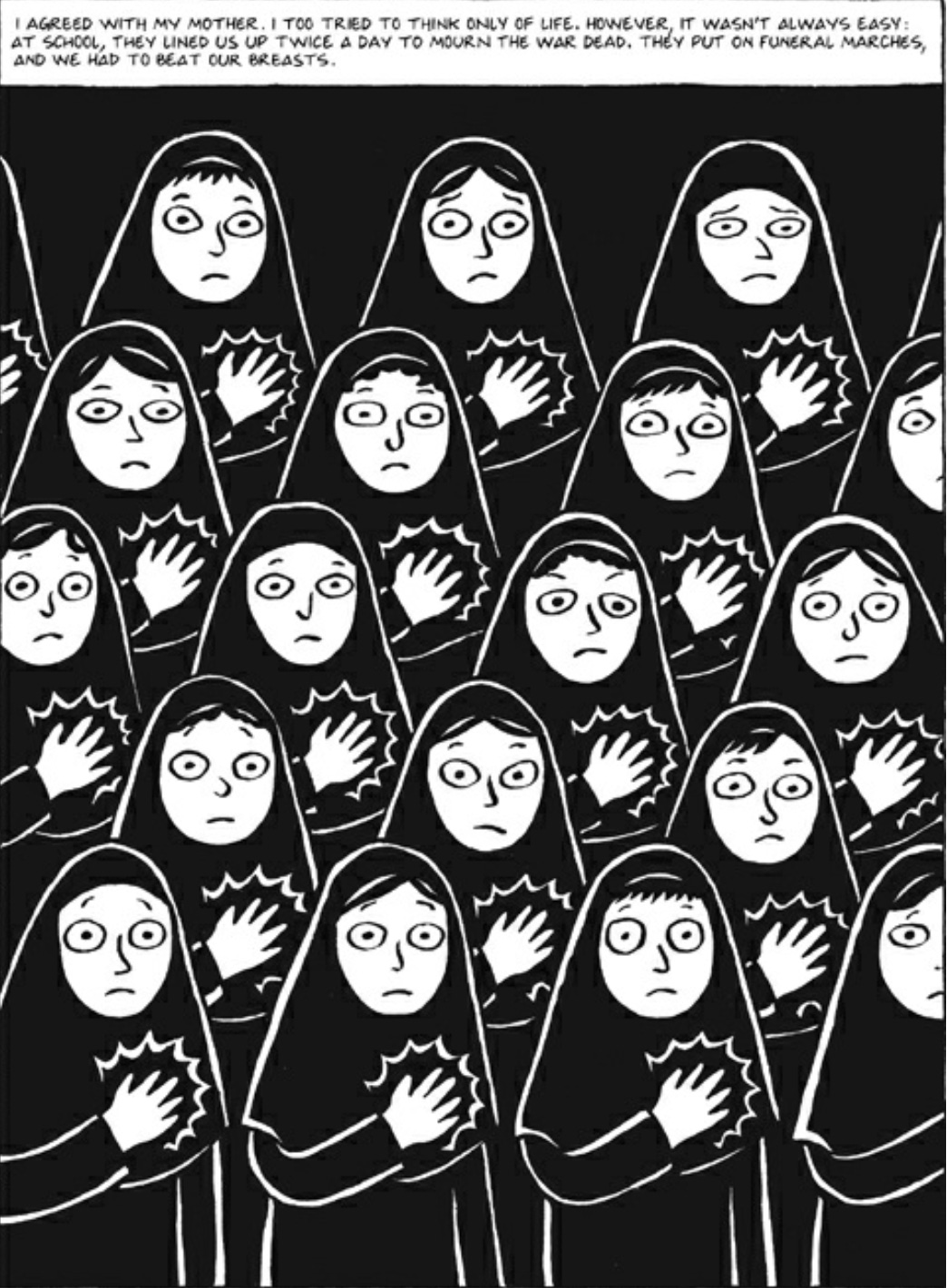
The fact that so many of my students admit that they are taking my Iran course because they’d read Persepolis in high school only vexed me further. Can I say the veil didn’t matter? Can I say that there aren’t families in Iran whose loved ones were not arrested, imprisoned, or killed by the Islamic Republic for holding onto another vision for the revolution? Can I say that being a young girl in Iran in the 1980s was not bound up with attempts to control her body, her words, perhaps even her thoughts at school and on the streets? Can I say that to have a party with dancing and alcohol in those years, was not an intensely fraught prospect haunted by the fear that at any moment security forces might rush in to arrest people and haul them off? Can I say that Persepolis’ history of Iran’s twentieth century — from Reza Shah all the way to the Iran-Iraq war — is simply and entirely wrong?
I cannot. Yet I could not simply affirm all these things, either, as each affirmation would only confirm a singular narrative and singular story of Iran. My job as a teacher and scholar is to discern where the certainties of my audience lie and to work to destabilize those hard-held beliefs by presenting a multiplicity of narratives. Persepolis as a work of art both powerful and popular makes that task a challenge.
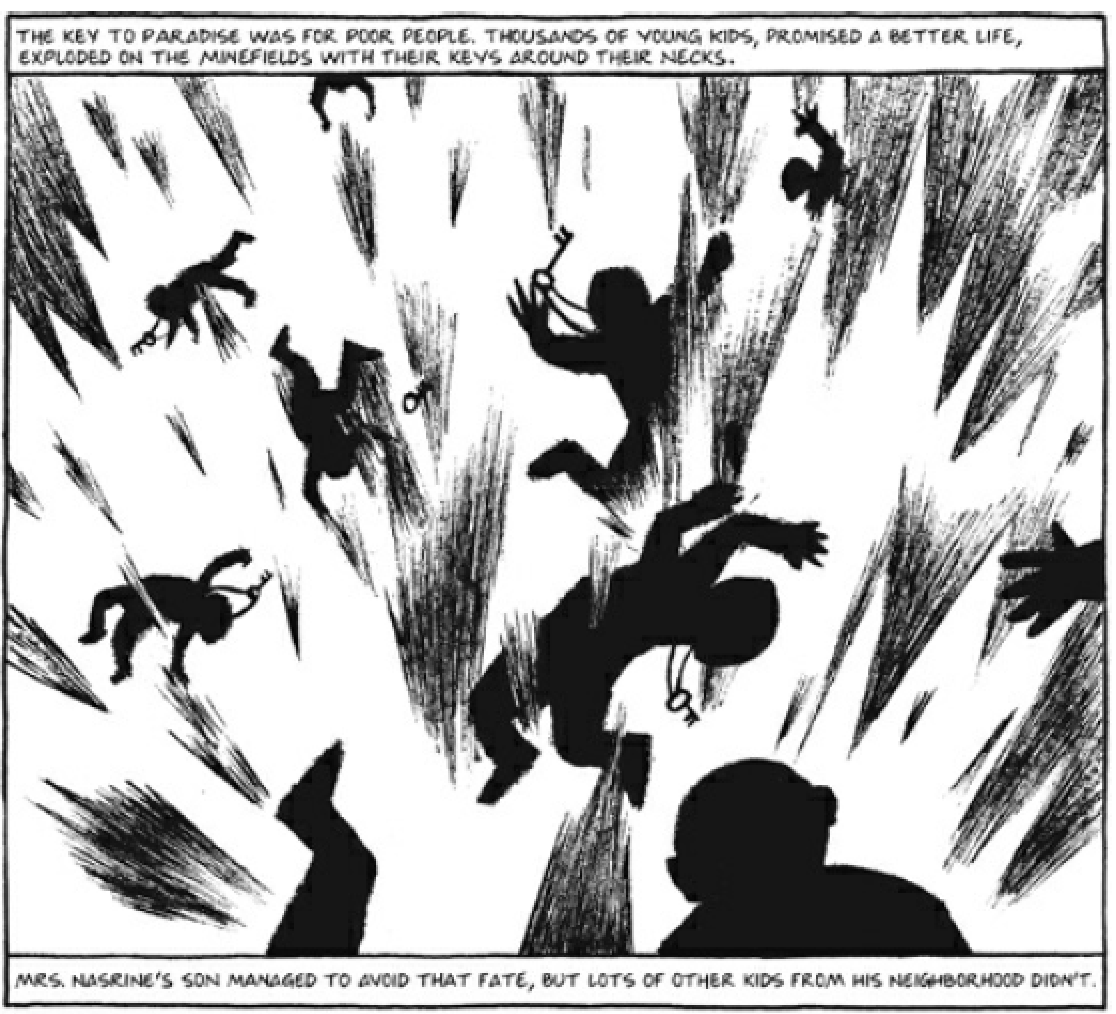
Consider one of the book’s most problematic chapters. In “The Key,” Satrapi centers the story of plastic keys that symbolized the key to paradise given to young boys from impoverished parts of the country who were then sent to the warfront as human waves to clear out mines by stepping on them. Marji is shown one of these keys by the family maid, whose fourteen-year-old son was being enticed at school to join the war. The boys, Marji tells us, were told that the key will open the door to a paradise of food, women, and homes made of gold and diamonds. At the end of the chapter, an affecting tableau of bodies thrown into the air, mid-explosion, their keys dangling from their necks, is contrasted with an image of Marji attending her first party, dancing.
Growing up in Iran at the same time as Satrapi, I am familiar with the plastic key to paradise. It was the kind of story that adults were wont to whisper to each other around kids, or that someone at a dinner party might loudly assert to emphasize the cruelty of the post-revolutionary state. To be honest, the first time I read Persepolis, “The Key” made me smile. It felt like an intimate family story, something that only those of us who had gone through the war together knew.
Every night on TV, we would see news reports or documentaries that portrayed these young men, boys really, preparing to face what was near certain death. My grandmother would slap her thighs when their faces appeared on the TV screen, saying: “May I die for you. May I die for your mother’s grief.” There was no doubt that thousands and thousands of young men were dying on the front. The story of the plastic key reflected the emotional devastation of being engulfed by what felt like an increasingly pointless yet bloody war.
So here was Satrapi not only remembering something so fleeting, she had given that memory the security and, the stability, of a story on paper, in literal black and white. Yet that stability is exactly the problem because, it turns out, the key was not real. It was a rumor that caught like wildfire and spread amongst those who were exhausted by a war with no end. I have no reason to doubt that Satrapi was shown a plastic key by her family maid. Maybe the principal of that school had purchased some plastic keys to give away to his pupils for precisely the reasons she gives in the book. But the boys who declared their willingness to die on TV never flashed their keys in front of the camera. Western journalists writing about this sometimes white, sometimes gold, sometimes imported from Taiwan, sometimes from Hong Kong plastic key never saw it themselves. The BBC journalist Baqer Moin speculated the rumor might have been started because for a while, a copy of a prayer book called “Keys to Paradise” was given to volunteer soldiers.[1] None of this has stopped the story from being treated as fact (even mentioned by Nikki Haley in a UN Security Council address in 2018),[2] with Persepolis often cited as one of the sources for its veracity.
The key was there and it was not there. It was true but it was not real.
The problem is not Satrapi herself. As an artist who had lived this life, in an upper middle class, secular, nationalist, leftist family with a maid and enough money to take family vacations abroad and to eventually send their daughter to Europe in the middle of the war, she owned her story and told it with verve, joy, and exuberant humor. The problem is the finite range of stories that are allowed by the publishing industry and Western readers to receive the stability of print that hers got. While the English-language literary world is replete with coming-of-age memoirs in America, some of which sparkle and others fizzle, there has always been a limit to the kinds of stories we get to tell about Iran. Imagine if JD Vance’s Hillbilly Elegy and Barack Obama’s Dreams of My Father were all that anyone knew of American childhoods. Now imagine if most people treated them as records not of individual lives but of an entire country’s past.
While Persepolis is, as Satrapi made clear in her subtitle, “the story of a childhood,” there are precious few stories of other Iranian childhoods in English that could be swapped out for it. It’s not there are no other memoirs. For a while, in fact, memoirs by Iranian women were all the rage. But they are almost always written by women from the same milieu as Satrapi, representing the same type of defiance as her, though never so vividly and so fully from the perspective of a child.
Persepolis remains a crucial part of my teachings on Iran but in tandem with another text. In 1981, the French sociologist Farhad Khosrokhavar conducted interviews with several teenage girls, including sixteen-year-old Moneer and fourteen-year-old Masume in the holy city of Qum. The sisters were true believers in Ayatollah Khomeini and the 1979 revolution, the kind of kids who are wholly absent from Satrapi’s memoir save as perhaps agents of her repression. Khosrokhavar draws the reader’s attention to how for Moneer and Masume, the revolution was also about defiance. These girls who were in every way different from Marji — poorer, more religious, and ideologically aligned with what they themselves insisted was an Islamic revolution — were also engaged in youthful rebellion against structures of authority at home and in the streets. As noted by Khosrokhavar, the teenagers he interviewed “each defines the boundaries of this liberty according to her own political ties. But on the desire to be free, there is no divergence.”[3]
In this sense, the stories of these girls, and so many others — including my own — are not a correction to Marji’s. They live inside the same revolution, waiting to be told, and maybe, to be heard.
[1] Baqer Moin, “Khomeini’s Search for Perfection: Theory and Reality” in Ali Rahnema ed. Pioneers of Islamic Revival, (London & New Jersey: Zed Books, 2005), p. 68.
[2] https://2009-2017-usun.state.gov/remarks/8660.html
[3] Farhad Khosrokhavar, “Attitudes of Teenage Girls to the Iranian Revolution,” in Elizabeth Warnock Fernea, ed., Children in the Muslim Middle East (Austin: University of Texas Press, 1995), 392-409.
 | A guest post by
|