



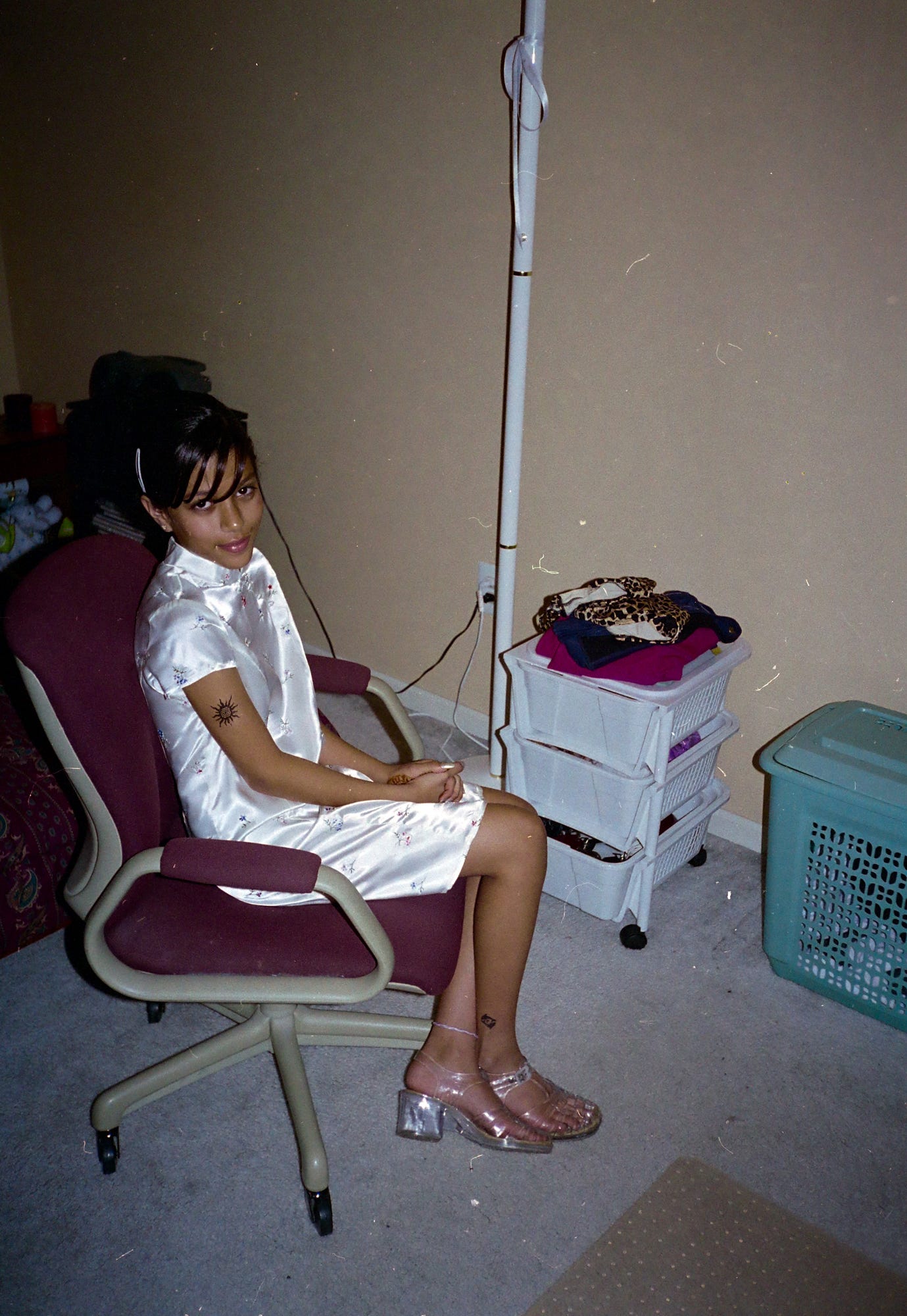
For Asma Maroof, sometimes known as Asmara, collaboration is alpha and omega. The musician has worked with such Bidounish artists as Fatima Al Qadiri, Sophia Al-Maria, and MIA (RIP), along with a slew of others, including Kelela, Wolfgang Tillmans, and Trajal Harrell. Her output spans contemporary art, film, theater, fashion, and club culture; you almost certainly know her by her work, if not her name. Maroof’s most recent release is The Sport of Love (2025, PAN), a sonic meditation on latter-day romanticism, made in collaboration with Patrick Belaga and Tapiwa Svosve. Alongside Daniel Pineda, her partner in life and work, she has been making music for nearly two decades as Nguzunguzu—a touchstone for twenty-first century musicians entranced by the possibilities of global club music.
In person, Maroof can be painfully modest. As ardent fans, we asked her to revive the Bidoun Mix tradition with “Moon Bouncers,” a playlist for a waning summer.
What were your primal musical scenes growing up?
I’m definitely an MTV baby: “Video Killed the Radio Star” vibe. I grew up listening to R&B and hip-hop. Especially R&B! In the fourth grade, I sang Boyz II Men’s “On Bended Knee” for the school talent show. I loved Brandy, Whitney Houston, Mariah Carey. I grew up outside Washington, DC, in Bowie, Maryland, where there was a really thick go-go music scene—basically gospel and punk and cover songs, everything all at once. Then there was the B’more I would hear on the radio, a genre of music, also known as Baltimore Club, which would sample everything from SWV to the Rocky theme song.
“Gonna Fly Now”?!
Exactly. And then on top of all of that was the music my Indian Muslim parents listened to. They’d stayed in India at partition, and come to the US in the early 1970s, in their mid-20s. Like most immigrants, they ate their own food and listened to their own music, so whenever we were in the car it would always be Nusrat Fateh Ali Khan, Mohammed Rafi, and all the Indian greats, with my mom singing loudly along and my father drumming on the steering wheel.
Beautiful. [Laughter]
And shout out to the soundtrack to the (1994) Hindi film 1942: A Love Story, which left an indelible mark. The film is about the son of a politician who falls for the daughter of a freedom fighter, I think? Though honestly, I mostly just remember the songs on that specific CD, which we listened to every day after it got stuck in our station wagon’s compact disc player until my dad surgically removed it. Indian music left a huge impression on me—the scales, rhythms, the mastery of voice, the ad libs. That mishmash was my acoustic universe as a kid, and it helped inform how I listen to and dig for music even now.
Tell us about the mix. There are some really special encounters between musical traditions. One of the first songs is a collaboration between the Algerian rapper Soolking and the Kosovar Albanian singer Dhurata Dora. There’re all kinds of sounds in play—Moroccan, Angolan, Punjabi. How did you go about putting it together?
Well, the mix is a gumbo of sorts, with some old and new ingredients. I am currently living in Maryland, back where I grew up, so I have been feeling very… nostalgic. I opened the mix with a song called “Straight from the Basement,” and I literally made it in my basement. It’s by Northeast Groovers, a go-go band dear to my heart and important to my musical DNA, and it just felt right. Then I go straight into Nusrat, the live version of “Mustt Mustt.” I know it absolutely makes no sense at all, but they totally relate in my mind. I recently heard that Albanian track in the car with my sister, and it made me want to be on a boat. There’s a track from Meriem Bennani’s Iraqi YouTube playlist, which blew my mind, and then my friend Lou sent me this USB full of incredible goodies, including “Sign your Name Across My Heart,” that Terence Trent D’Arby song that The California Raisins ended up covering. That one took me back to childhood. Also Diamond K’s “Are You the Bomb” was a throwback local radio anthem that still holds strong.
Where do you find stuff?
I’m constantly looking and also… never? I love YouTube and am that naughty girl who plays many rips from YouTube, Bandcamp, dusty Soundcloud, films, old records. Most definitely it’s friends who send me the best of the best music that I cherish and rinse out for eternity—love you guys!—and shout out to DMV [DC, Maryland, Virginia] radio, still and always my inspiration, even though I’m more on the oldies station as of late. I also like to open my ancient hard drives and dig up some lost vintage archival material…
The cover songs on the mix are incredible. A lot of them—like Ace of Base’s “All That She Wants” in Tunisian Arabic—have been transformed by the act of translation. What role does diaspora play in your musical universe?
A major role. I think it really informs how I listen and what I want to hear. I’ve always been attracted to songs that are remixed or recontextualized. I love to see how music travels and adapts in new places. Like that Jojo Darbuka song—crazy, right? The way identity itself gets remixed, sort of de centralized, and how the Darbuka remix is an upgrade. And there’s the version of “Take My Breath Away,” the Berlin song, that Sandy Lam did for the soundtrack of Wong Kar Wai’s As Tears Go By—it really transcends the original, don’t you think?’
There’s also a track by Fatima Al Qadiri on the mix, an old mutual friend of ours.
The track is from Medieval Femme, maybe my favorite of Fatima’s albums. We have a beautiful relationship. She’s my mentor, my bestie, my confidante. I feel lucky to have her in my life. She makes me laugh like no one else. In the beginning there weren’t that many women in our music game, so we shared everything from DJ rates to mp3s. And then around 2015, we had a short-lived band called Future Brown that started because we found ourselves, as producers, wanting to make music for vocalists, even pop songs. Future Brown also included Daniel Pineda and Jamie Imanian Friedman (aka J-Cush). It was a mess because we all lived in different places, so to get together in one room was a production feat in itself, and then working with the vocalists required a whole other cat-and-mouse game. After the first LP, we attempted a second, but it fell through and is now buried treasure. That whole process was beautiful, and we still bounce ideas off one another. I hope we have more musical collaborations in our future.
Collaboration is a big part of your practice. You spent years working with the Schauspielhaus Zurich and collaborating closely with Wu Tsang, Tosh Basco, and Josh Johnson. You’ve worked with Kelela, Wolfgang Tillmans. . .
Collaboration is the most fruitful posture for me as an artist. Solo, I tend to overthink and then hate on myself, so it feels good to feel my way through something as part of a team. Stronger in packs. I’ve worked with Wu for twenty years, including on her art films like Wildness and Into a Space of Love. Then one day she said she’d gotten this wild opportunity to direct at Schauspielhaus, a government-funded theater in Zurich that has been running since the 1900s. She invited me, Tosh, and Josh to come along. We made things as Moved by the Motion. The theater had new creative directors, and they wanted to bring younger people in because their audiences were old—quite literally dying. We were there for five years and made some beautiful things: interpretations of Carmen and Robin Hood and Pinocchio. We opened our residency there with Sudden Rise, a collage piece we also performed at the Whitney Museum based on a conversation between Wu, Tosh, and Fred Moten. Eventually there was some backlash as the conservatives in the country were like “this isn’t ‘real’ theater,” which was very confusing because basically all of our shows were sold out.
I’ve also worked with Kelela for many years, Trajal Harrell on a couple performances, Tapiwa Svosve and Patrick Belaga on our PAN EP and scores, Martine Syms, Mahfuz and Chloe Sultan, and also Sophia Al-Maria and C. B. Evans on their films, ads, and fashion shows. My most important collaboration is with my husband, Daniel Pineda. We’ve made music together as Nguzunguzu since the year 2008. He’s been there through it all. We do what many cannot do and work together as lovers. It’s absolutely insane, but I would have it no other way.
What are you working on at the moment?
Daniel and I are working on an album, which has long been a dream of ours. I mean, we have never stopped making music and have maybe five album folders in our Dropbox that have never been released. It’s kind of a combination of a lot of things we’ve been thinking about for the past decade: score work, installation, and our usual club music bag. It’s very hard to explain because, like my tastes, it goes many places—a mishmash, per usual. But you will know when you hear it that it’s Nguzunguzu.
You’re moving back to LA after years away. What are you most looking forward to, musically and otherwise?
I lived in LA from 2009 to 2019—basically until I moved to Zurich. Those were huge DJing years. Many of the venues I played in aren’t even around anymore. Like this place called the Silver Platter where Wu and Ashland and Daniel and I did a party called Wildness for a couple years. Then there was M Bar, a really special after-hours jazz bar in Chinatown that also got shut down. El Cid was where Nacho Nava, a pillar of our community, organized Mustache Mondays for many years. He’s gone, though I believe El Cid is still there. I know it sounds desolate now, but we built a huge community when we were there that I’m excited to return to. I’m also at a different stage in my life and don’t know if I can stay up anymore. Like, sorry, but I turn into a pumpkin at 9pm! But I do love a daytime hang, like Soul Summit or something. Come meet me at the moon bounce in Elysian park at 2pm, and I will bring the trance playlist—wink wink.
TRACKLIST
00:00–00:52 Northeast Groovers — Straight from the Basement
00:52–01:28 Nusrat Fateh Ali Khan — Mustt Mustt (live)
01:28–2:16 J Dilla — Waves
2:16–3:17 Kumar Sanu — Ek Ladki Ko Dekha
3:17–4:42 Mc Bruninho da Praia, Mc Kevin, Mc IG, MC Magal,
Mc GP & DJ Oreia — Giro dos Artistas
4:42–5:26 DJ A-B — jojo darbuka
5:26–6:00 Dhurata Dora ft. Soolking — Zemër
6:00–6:56 DJ Xtreme — Bollywood Lovers (Wifey Riddim Remix)
6:56–8:08 SISQO SLOW CALL TO PRAYER
8:08–10:24 DJ Sanj — Lishkaray Teray Kokay (MA CHOP)
10:24–11:49 DJ Yannishouu — yanN’ShoU neW Déliire LogobiZouké
11:49–13:10 Pure Elegance — Mix It Up
13:10–13:58 Rufus feat. Chaka Khan — Sweet Thing
13:58–15:48 DJ Radikal — Only TIme Kizomba
15:48–18:12 Fatima Al Qadiri — Qasmuna (Dreaming)
18:12–20:17 Sandy Lam — 激情
20:17–22:29 Ace Of Base — All That She Wants (Tunisian cover)_صو_قرتاج
22:29–23:54 DJ Narciso — Do Jo
23:54- 24:50 جوبي - كل الهلا - حبيبيي اسمر جكليته - يمه الثوب داريه - سوسن نجار
24:50–25:10 Yeshe — Sound of Yonder
25:10–26:14 DJ Figo — مزيكا الخروطه shimmyesque 2010
26:14–27:31 Elyanna — Ganeni
27:31–28:24 Terence Trent D’Arby — Sign your Name
28:24–29:06 Sam Gendel — Sax Market
29:06–29:50 Shabjdeed & Al Nather — Rad Saree3 (feat. Riyadiyat)
29:50–30:20 Diamond K — Are you the Bomb?
30:20–32:10 Kehna Hi Kya (A.G’s VIP Remix)
32:10–34:06 Manara- Dhak Dhak x J Sweet (Live Blend)
34:06–37:16 Morad — Pelele
37:16–38:26 DJ Hakki — Are you from Bubbling?
38:36–39:17 Omar ؏ — KU KU
39:17–41:45 DJ Swami — Pyar Tere Nal
41:45–43:50 Nimco Happy — Isii Nafta UK Drill Remix
43:50–45:50 DJ Travella — Mchakamchaka