



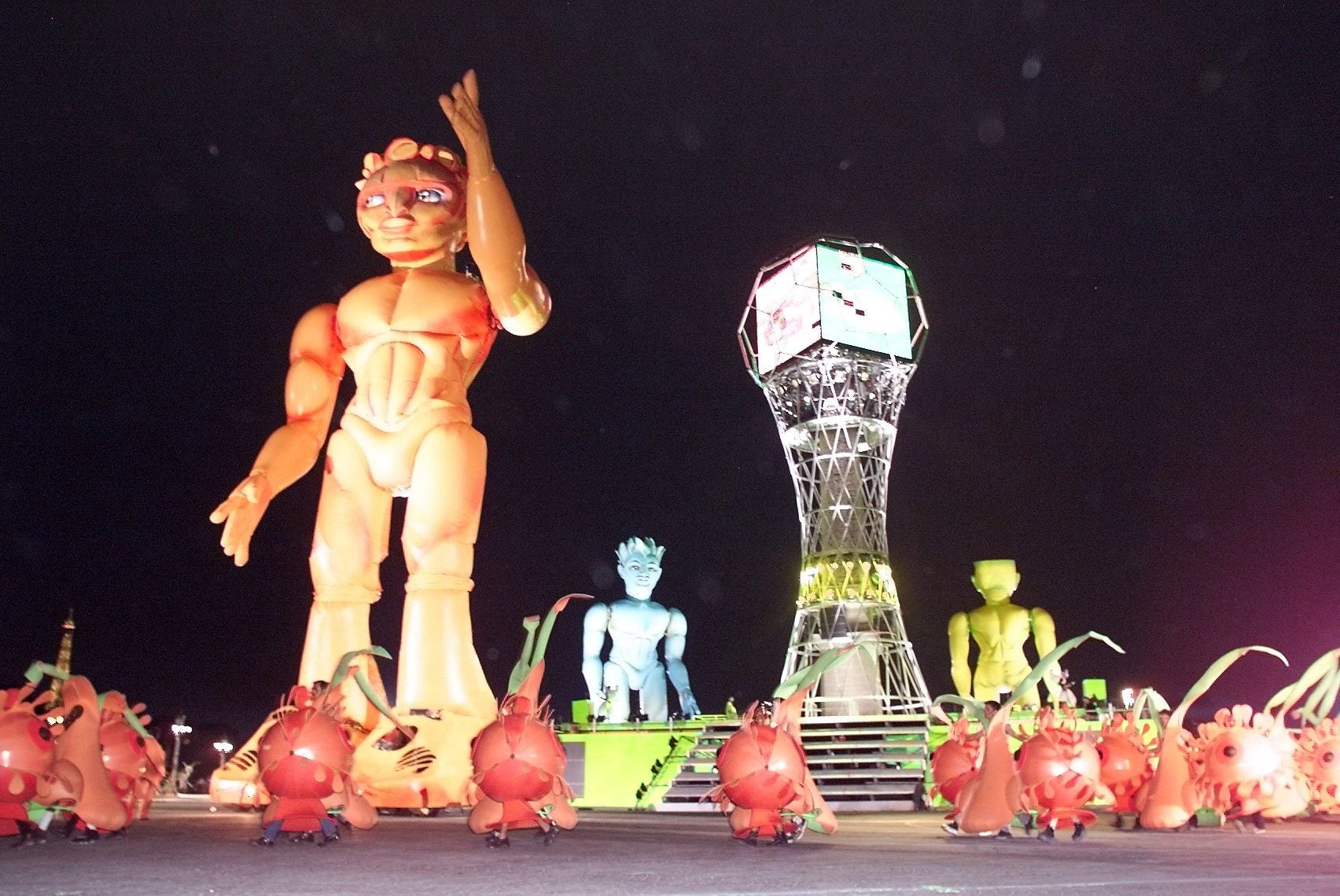
FOUR MONUMENTAL, INFLATABLE ROBOTS—one African, one European, one Asian, one (vaguely native) American—marched through Paris before the 1998 World Cup, each gritting its teeth while smiling at its taxonomic assignment. From a distance they looked colossal, almost sovereign. Up close, you could see the cars that moved their feet. Apparently, FIFA, like most of the West, once thought four blow-up dolls could represent all of humanity.
Every World Cup opening ceremony suffers from the same problem: how do you represent the great big world’s plurality while keeping the game identitarian? For the 2002 World Cup, held in Japan and South Korea, FIFA had to persuade two countries with a mutual distaste for one another to cohost some footy. Their solution for the celebration was ingenious: omit the history the two nations shared and replace it with a universal tale set within a Benetton cosmos of children, taiko drums, and what appeared to be a crane. The result looked like a hot-yoga class staged at a galactic scale.
Germany, in 2006, offered a Panglossian commercial for what the European Union then believed was its principal export: reconciliation. (The border panic had not yet commenced.) Large, brightly colored, inflatable footballs—seemingly the official symbol of hollow, post-Cold War internationalism—drifted across the pitch. Performers from dozens of countries converged into what the organizers called a Greek chorus—ironic given that the IMF, on behalf of Germany in part, would, in short order, come calling as debt collectors at the Greek Parliament.
South Africa’s 2010 ceremony attempted to represent an entire continent in ninety minutes, and succeeded just often enough to make the failures interesting, including the appearance of a giant dung beetle. The spectacle resolved into a stadium-size drum circle because, apparently, what’s more African than drums and black people smiling? Brazil in 2014: Carnival, everyone is beautiful. Russia in 2018: ballet and space exploration. Old chestnuts all the way down.
Qatar, in 2022, dispensed with nationalism altogether and, in lieu of Allah, tapped Hollywood’s favored god of color, Morgan Freeman, to explain Arab hospitality. “Am I welcome here?” the actor asked, seated across from Ghanim Al Muftah, a young Qatari disability-rights advocate, as if the preceding centuries’ wars, arguments, and hullabaloos had just been one big misunderstanding. BTS’s Jung Kook sang, every mascot in World Cup history reappeared, as did a Middle Eastern-looking Casper wearing a ghutra. It was globalization as air-conditioned extravaganza. There was, once again, drumming.
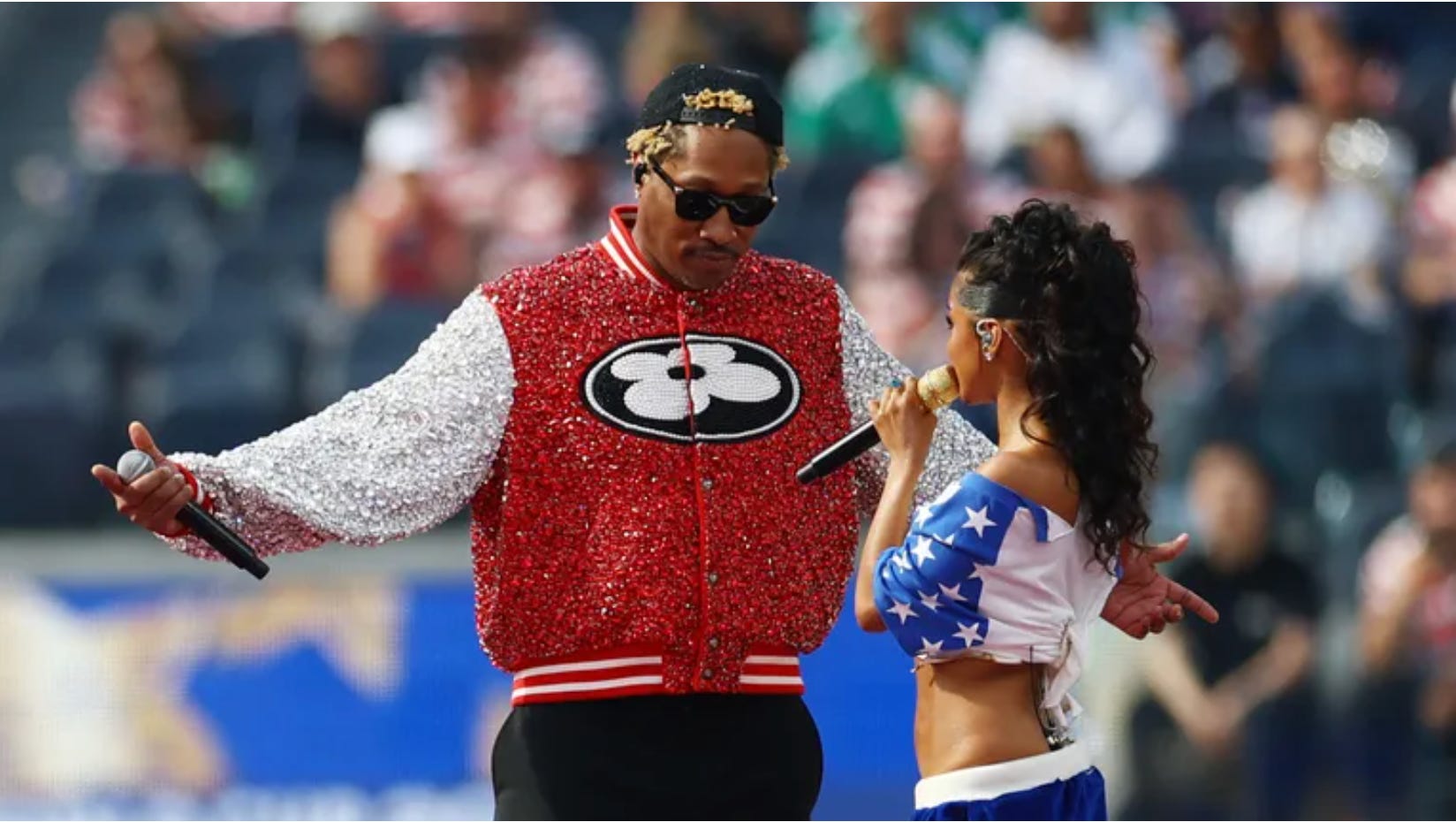
As one of the hosts of the World Cup this year, the United States did what it does whenever guests arrive: subjected them to a halftime show. Football doesn’t have halftime shows, but America cannot conceive of a sporting event without a commercial break—and what is a halftime show but the tackiest commercial break ever invented? Katy Perry and Future opened the ceremonies in Los Angeles. I love Future. He raps about Lean—a lavender sacrament of codeine syrup and soda—and cuckolding his rivals, often while wearing flip-flops. Perry was still coming down off the high of her eleven minutes in space, the first time in years her act had left the ground. The ridiculous pairing of these two made a certain sense. Future represents an American subculture that has become a phenomenon; Perry represents a phenomenon that’s been eroded into, well, nothing.
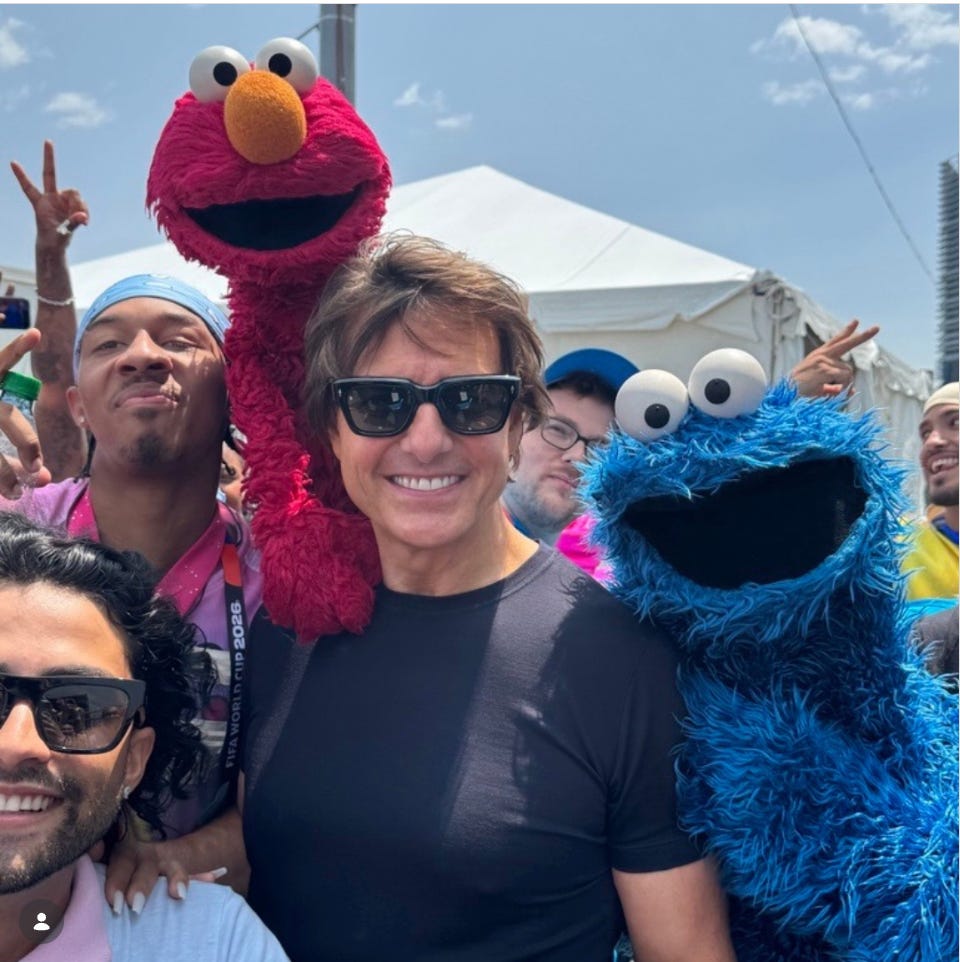
Whatever this country starts, it inevitably ends in the most embarrassing way possible. Post Malone, aka White Iverson, headlined the close of the games in New Jersey, with Madonna (representing the US), BTS (all of Asia), Justin Bieber (Canada? Let’s say Canada), Shakira (Latin America), and Burna Boy (Africa) interrupting the game with the second-ever World Cup halftime show. On the sidelines, Elmo made a new friend in Tom Cruise. One is a puppet, the other is on Sesame Street. Both are globally legible intellectual properties.
By the end of the tournament, it was clear that America trusts only one language: that of a Madison Avenue on Lexipro, Adderall, and GLP-1s. The blandness of their shows was not a failure of imagination. The US was overtly asserting its affinities for internationalism without issuing foreigners anything more than temporary visas. In the High Trump era, immigration was the one international movement the US did not represent; instead, it welcomed the rest of the world as talent, décor, customer, or opponent. If we were going to honor the current state of the union, ICE should have danced on the fields. According to the DHS, they were already at the games, apparently focused on preventing the sale of counterfeit goods, though civil deportation was not ruled out—so why not let them gyrate, or brandish their weapons in a kick line?
GOOOOOOOAL™!!
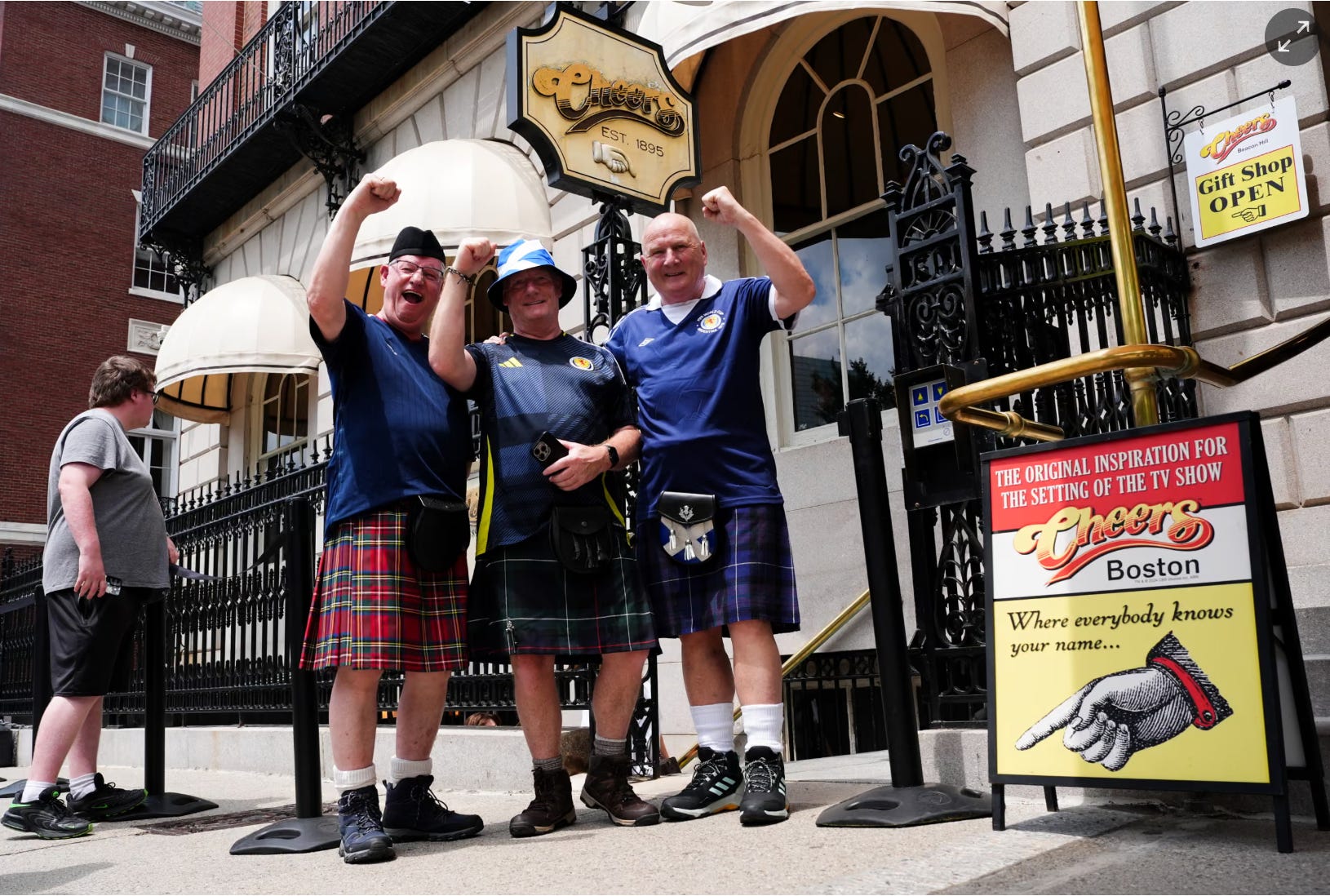
I have reached the age when ignorance of soccer no longer embarrasses me; there will always be some global obsession one has missed. But who could ignore the millions of people focused on twenty-two men and one ball, fans explaining formations to non-fans—Triangles! Don’t you see the triangles?—as the non-fans dumbly nodded, unable to escape football’s force majeure? What I came to appreciate was the simultaneity of the experience. It was miraculous. For thirty-nine days, a global covenant was shared and agreed upon. The same highlights circulated through WhatsApp groups of friends and family, inside apartment buildings and bars. Photos were posted of Scots in kilts drinking Boston under the table. Boston ran out of beer—another miracle.
Whether the outcomes were contested or will be litigated online for millennia, all agreed the games actually happened. If you drank enough and squinted, you might even see solidarity—and for a while, we drank enough. Then, one afternoon, the World Cup ended. City streets received a deep cleaning. The locals sobered up and went back to work. Visitors flew home after TSA checked their passports. Yesterday’s covenant gave way to the old incompatibilities—talk of who belongs where—and I found myself missing those damn inflatable robots.