



PERHAPS BECAUSE HUMAN DESIRE exceeds the bounds of language, we borrow words from other species to try and understand it. Cocks and cunts abound in contemporary parlance, as does the term that arguably stands at the top of our sexual taxonomy: pussy.
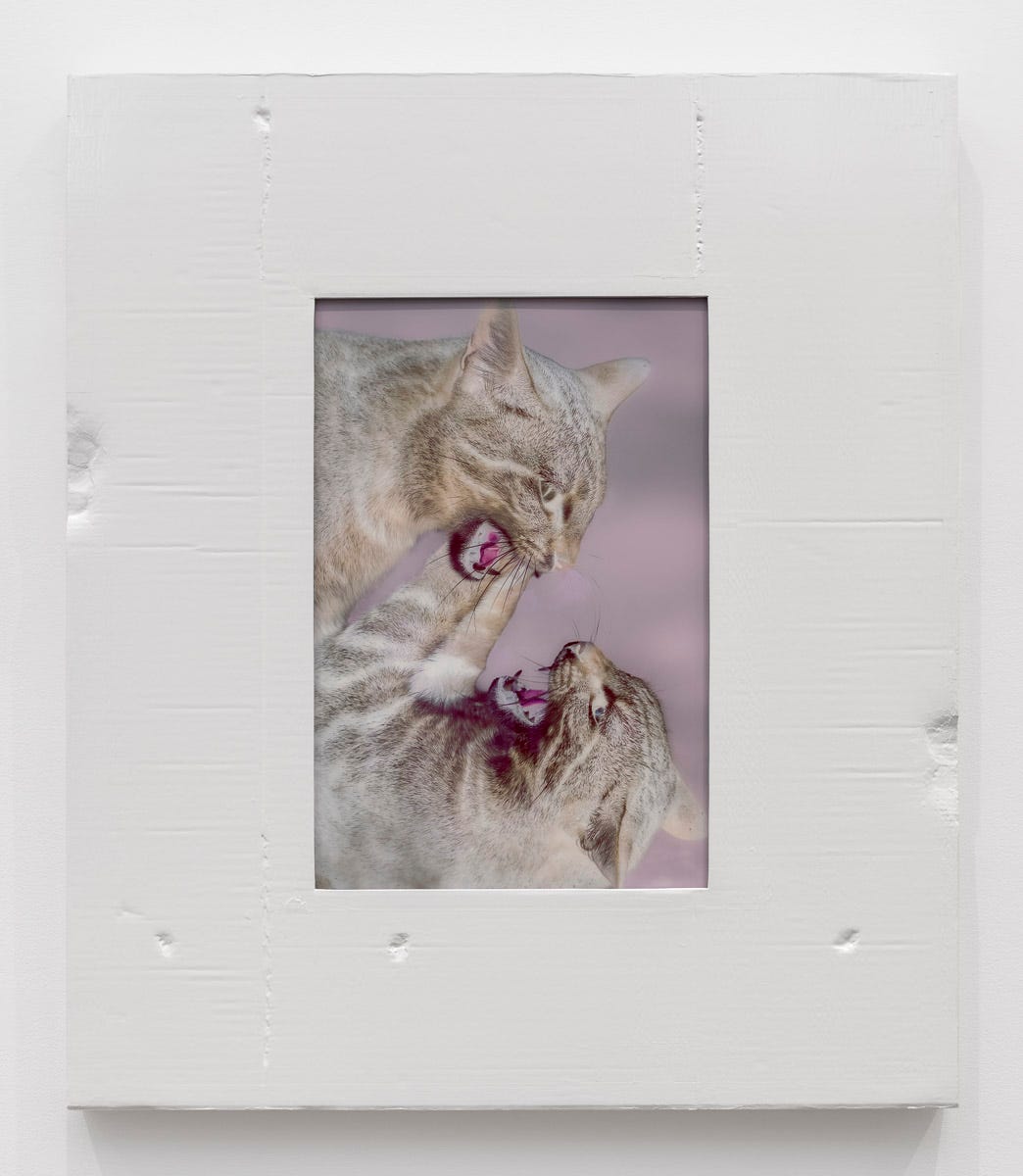
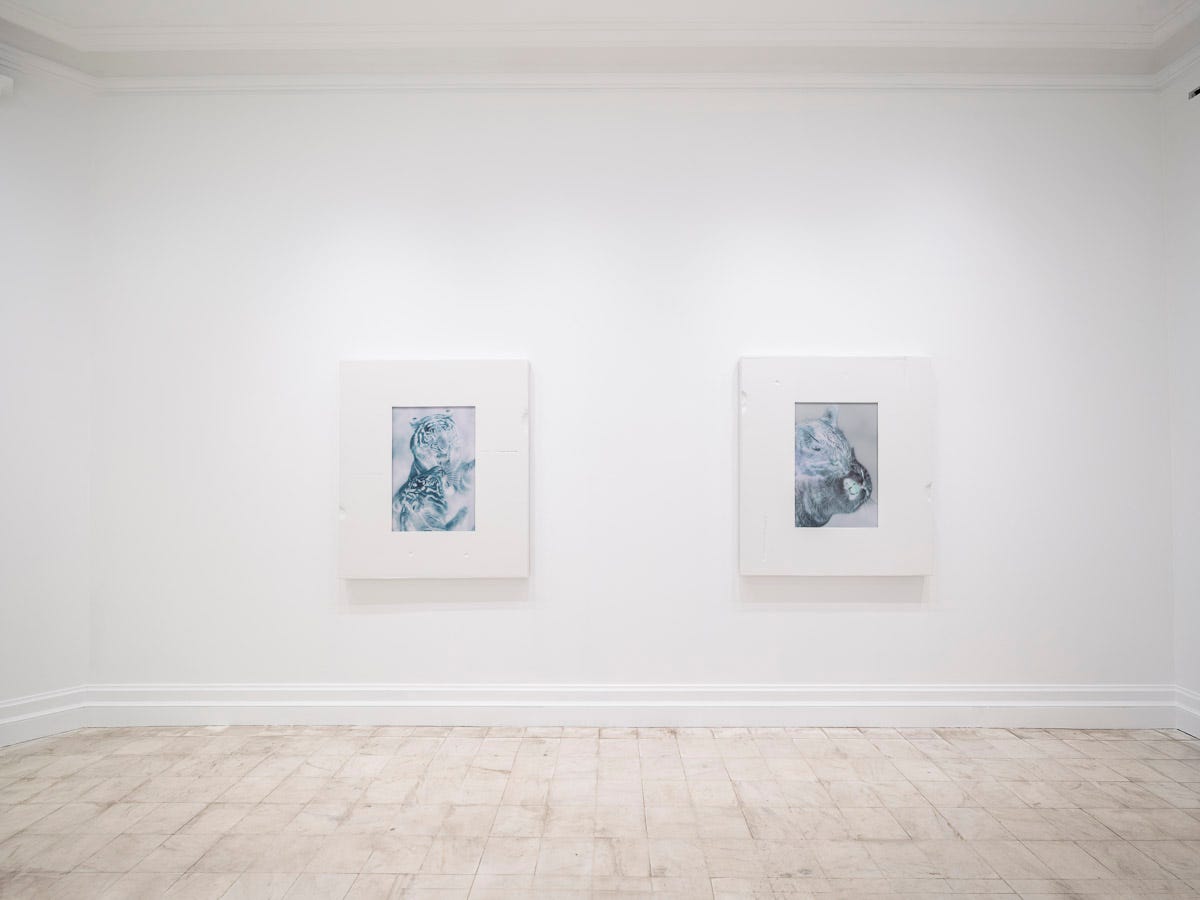
Artist Shahryar Nashat’s latest show at Gladstone Gallery, Beast in Both Palms, happily slips between pussy’s multivalent meanings, using cats to probe the mess of human eros. Anchoring the exhibition are five selections from a new series of solarized digital photographs featuring pairs of fighting felines, both wild and domestic. Nashat is interested in these beasts as uncanny doubles of each other, and of us, so it makes sense that he would swap warm hues for cool ones and dark tones for light. These shifts in color destabilize the images, making it difficult to distinguish where one animal ends and the other begins. But the artist also leaves a few colors untouched, particularly those of the cats’ fleshy mouths. Against the blues of their solarized bodies, their pink tongues read like hot spots on a thermogram, turning the affective register of the photographs on their heads, transforming a hiss into a kiss.
Born in Switzerland to Iranian parents and currently based in Paris, Nashat has spent the past quarter century creating videos, photographs, and sculptures that query how we experience desire and intimacy in a contemporary moment marked by social distance and digital surveillance. His installations typically include abstract sculptures alongside both still and moving images that feature bodies of various kinds. The male nude is a longstanding subject, while the animal is a more recent one; his 2024 exhibition Streams of Spleen at MASI Lugano included a video of computer-generated wolves. Nashat has also excavated the body’s innards. I first encountered his work in the 2022 exhibition, Raw is the Red, at the Art Institute of Chicago, where the artist installed a mixed media work—an inkjet print with acrylic—of a bovine carcass from a slaughterhouse, which he placed in front of a phallic sculpture. Depending on the viewer’s perspective, the “meat object,” as Nashat called it, uncannily resembled the glans of a penis. I was mildly disgusted, yet oddly entranced.
Most of Nashat’s sculptures are made of obdurate materials like stone and resin, but his fleshy color palette always augments their feel. Like Cy Twombly, a queer artist to whom he owes a great debt, Nashat frequently uses rosy hues to signify sex, imbuing an erotic charge within otherwise abstract forms. Also like Twombly, he is obsessed with the entanglement of Eros and Thanatos. Anchoring Nashat’s 2019 show at the Swiss Institute in New York City was the pale pink polymer sculpture, Start to Beg. About six feet long and recumbent on the floor, the object eerily resembled a cut of meat, or perhaps a sarcophagus, deformed by bite marks and scratches. It evoked the erotic as haunted by the specter of violence. Because Nashat prescribes no easy relationship between the figurative and the abstract, his work resists tidy narratives, but a thesis could be written on the film projected alongside Start to Beg, for which a camera explores every pore, hair, and crevice of a male armpit (a much-fetishized body part within the queer community). The film speaks to the persistence of desire amid the steel and concrete forms of a postmodernity that might otherwise neuter or destroy us. Simply put, humans get turned on by the weirdest things.
Memories of these earlier sculptures colored my viewing of the cats in Beast in Both Palms. I couldn’t help but imagine that they were responsible for the maiming of those earlier sculptures, whether due to coitus or quarreling. While the cats in the show’s lead image are clearly engaged in battle, the others seem suspended in more intimate scenes; to my eyes, all project a panoply of emotions. With both mouths open, and one’s paw placed on the other’s shoulder, the tigers in one of the photographs appear lustful, on the cusp of a snog. In another, one placidly looks up at its partner, concerned, as if trying to deescalate a conflict. One of the house cats seems to be yelling at its other for some minor domestic infraction, like failing to take out the trash. The tigers in the exhibition’s pinkest image gaze directly at the camera like they’re posing for an Instagram selfie to reassure their followers that their relationship is 100% secure.
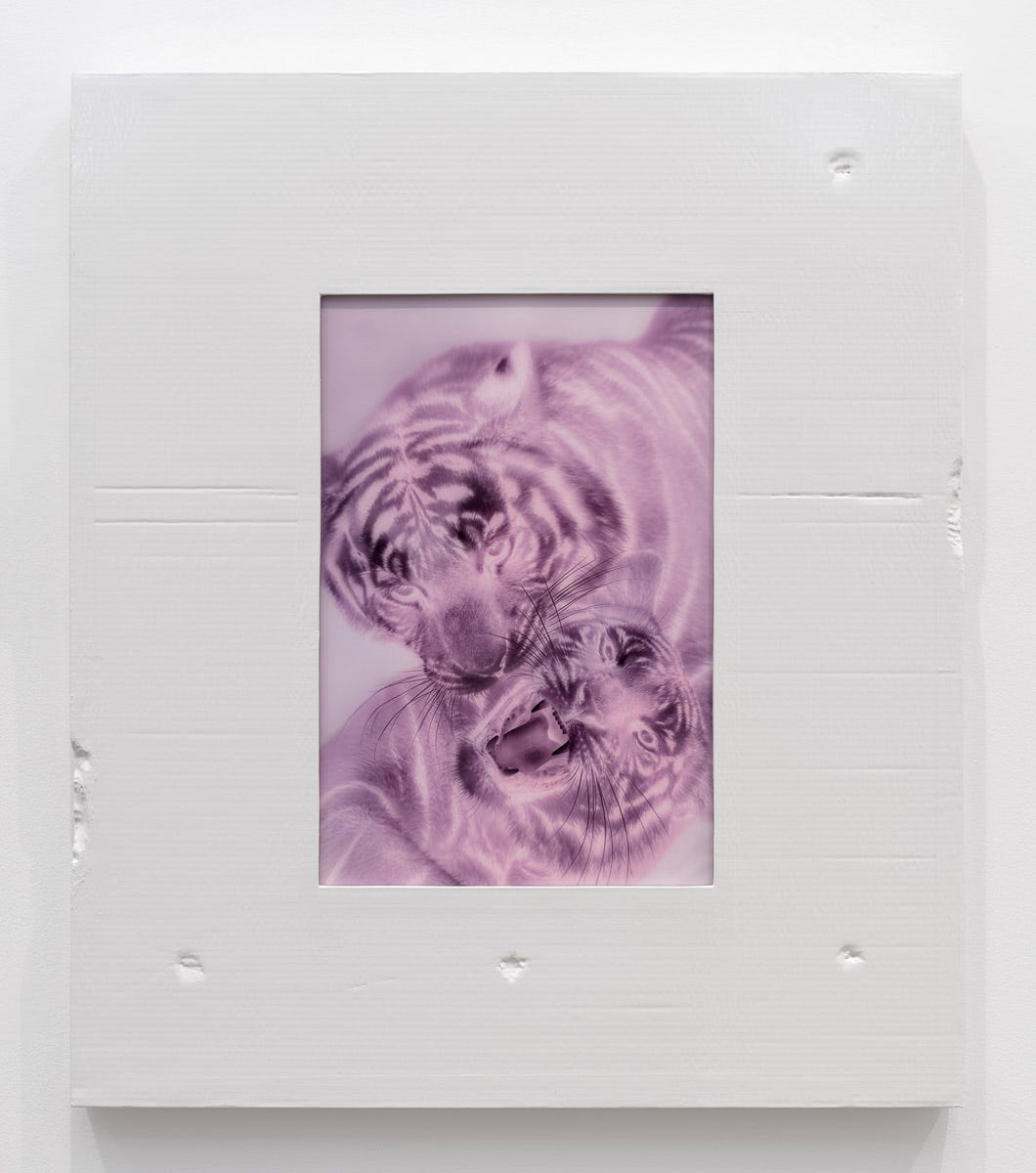
Whether human or animal, the bodies in Nashat’s previous works are typically isolated and fragmented—we see only one creature at a time, and even then, glimpse only parts of their personages. Beast in Both Palms marks a notable departure, presenting bodies in relation to one another and in so doing, foregrounding the social purpose of the aggressions depicted. Cats are not violent creatures by nature; they fight to release the tensions bubbling beneath the surface. Anyone who has cared for a pair of cats knows that their transgressions are temporary, undermining peace only to restore it, allowing them to maintain a healthy relationship to their packs. Ethologist and zoologist Konrad Lorenz, who is quoted in the exhibition text, argues that animal aggression can be a highly stylized form of communicating. Sometimes, it means “I love you.”
Here my thoughts turned to Georges Bataille’s infamous invocation of pussy. In his 1928 novella Story of the Eye, an unnamed male narrator first encounters Simone, “his cousin,” as she lowers her labia into a dish of milk meant for a cat. The narrator is in awe. Acquiescing to her alphaness, he curls up at her feet like a feline. So begins their perverse affair, which sees them engaging in an escalating series of violent acts in pursuit of sexual gratification. “The human spirit,” wrote Bataille in the opening line of his 1962 treatise Erotism, “is prey to the most astounding impulses.” But this is not simply pleasure for pleasure’s sake. An ontologist of the erotic, Bataille believed that sexual taboos shackled man to his worst fears about himself—alienating him both from his body and from the rest of the natural world. By crossing a taboo’s nebulous bounds, Bataille hoped, man might find connection by recognizing that the same dark desires propel us all.
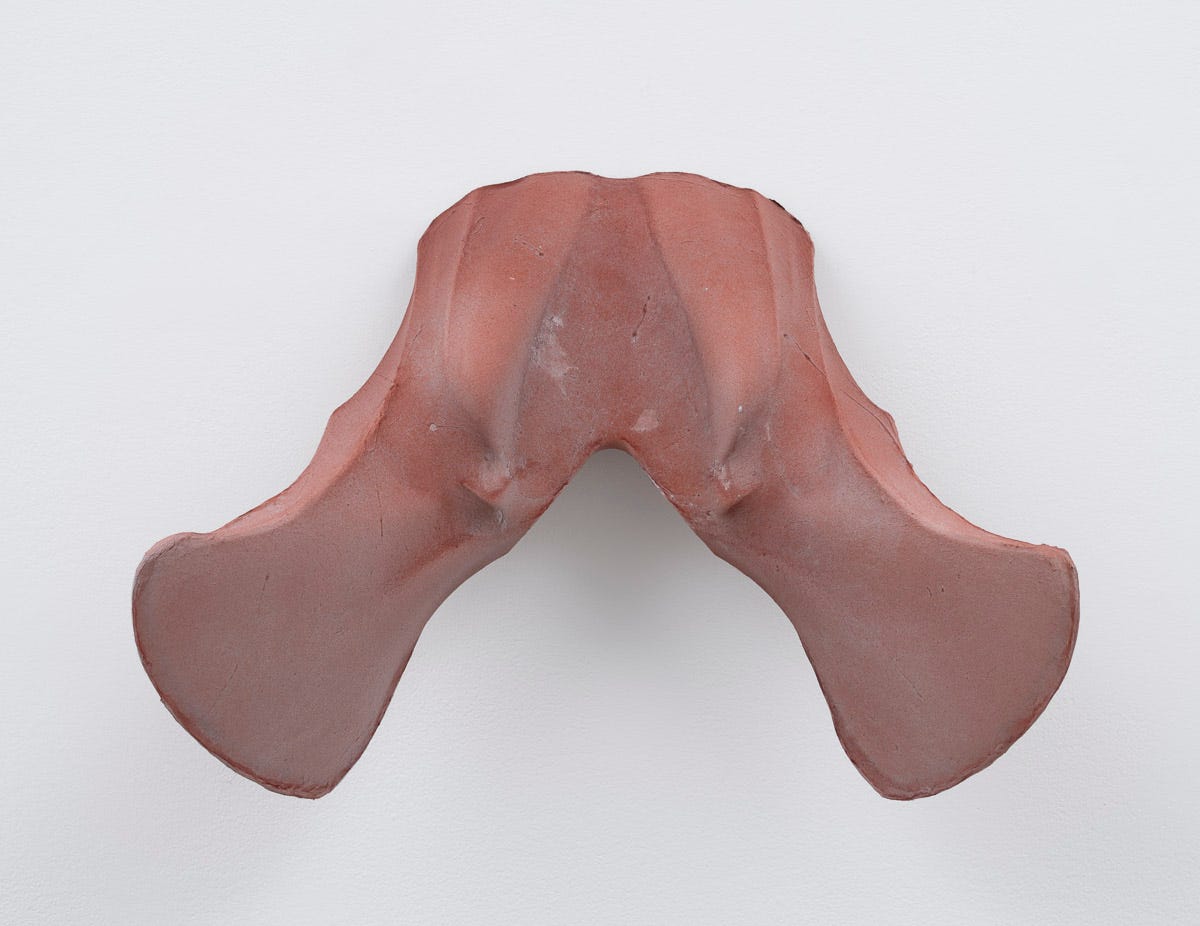
French philosophers love their puns, and erotism is one of the cleverest, combining “eros” and “rot.” Nashat also seems to see sex and death as inextricably linked, bound together like bones of the body. Bataille’s insistence that transgression supports the health of the social corpus is perhaps most clearly mirrored in the artist’s show by a series of sculptures titled Mothers. All are abstract, vaguely resembling fallopian tubes and a pelvis, through which new life is generated and brought into the world. Yet these sculptures are also dull in color and matte in finish, making them feel more like skeletons, less like flesh.
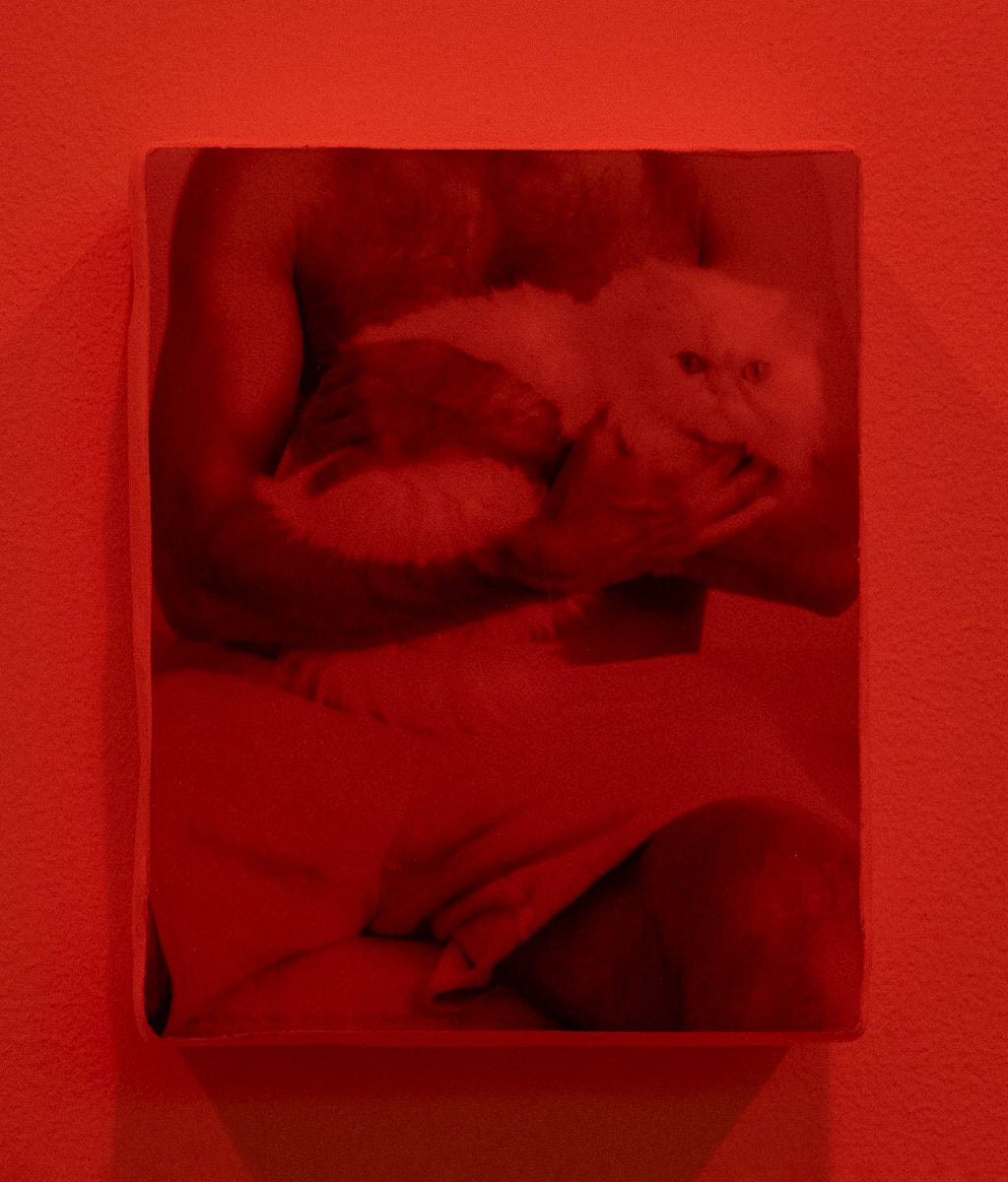
Hung on its own in the gallery’s lower level is a small photograph on acrylic and epoxy, approximately the size of a hand. Nashat bathes his greyscale composition in red light so that it recedes into its surroundings. The photo is easy to miss, but an important index. It features two bodies: a hirsute Persian man (who, as it turns out, is Nashat himself), and a fluffy Persian cat. His face is out of frame; we see only his muscular arms, and his legs peeking through terry cloth shorts. Cradled in Nashat’s lap is the show’s literal beast in both palms. Unlike the cats in the solarized images, this one seems devoid of emotion.
A subtle humor often pulses through Nashat’s work, so I couldn’t help but see the image (virile stud, docile pet) as a sly mockery of the faceless, peacocking men on hookup apps—or perhaps a sendup of a queer man who signals his proclivities via a fancy cat. Together, the two also conjure the complexities of good breeding: one might feel the joys of his animal nature, consensually ejaculating without a condom, while the other has been genetically modified to achieve some other ideal of animality. Though Nashat holds the Persian tenderly, I imagine it is not with this cat that his true allegiances lie. That designation is likely reserved for those fighting and fucking upstairs.