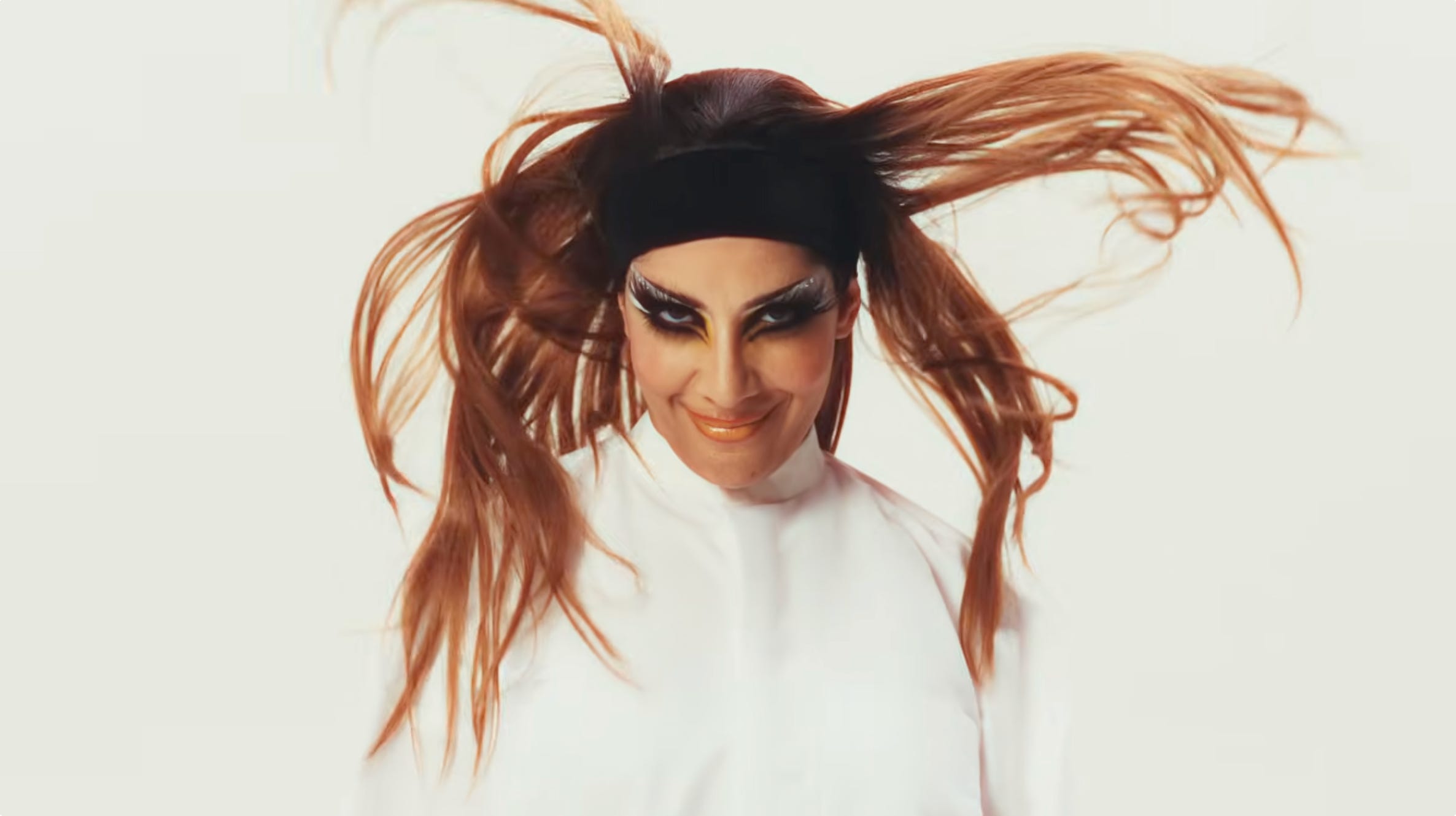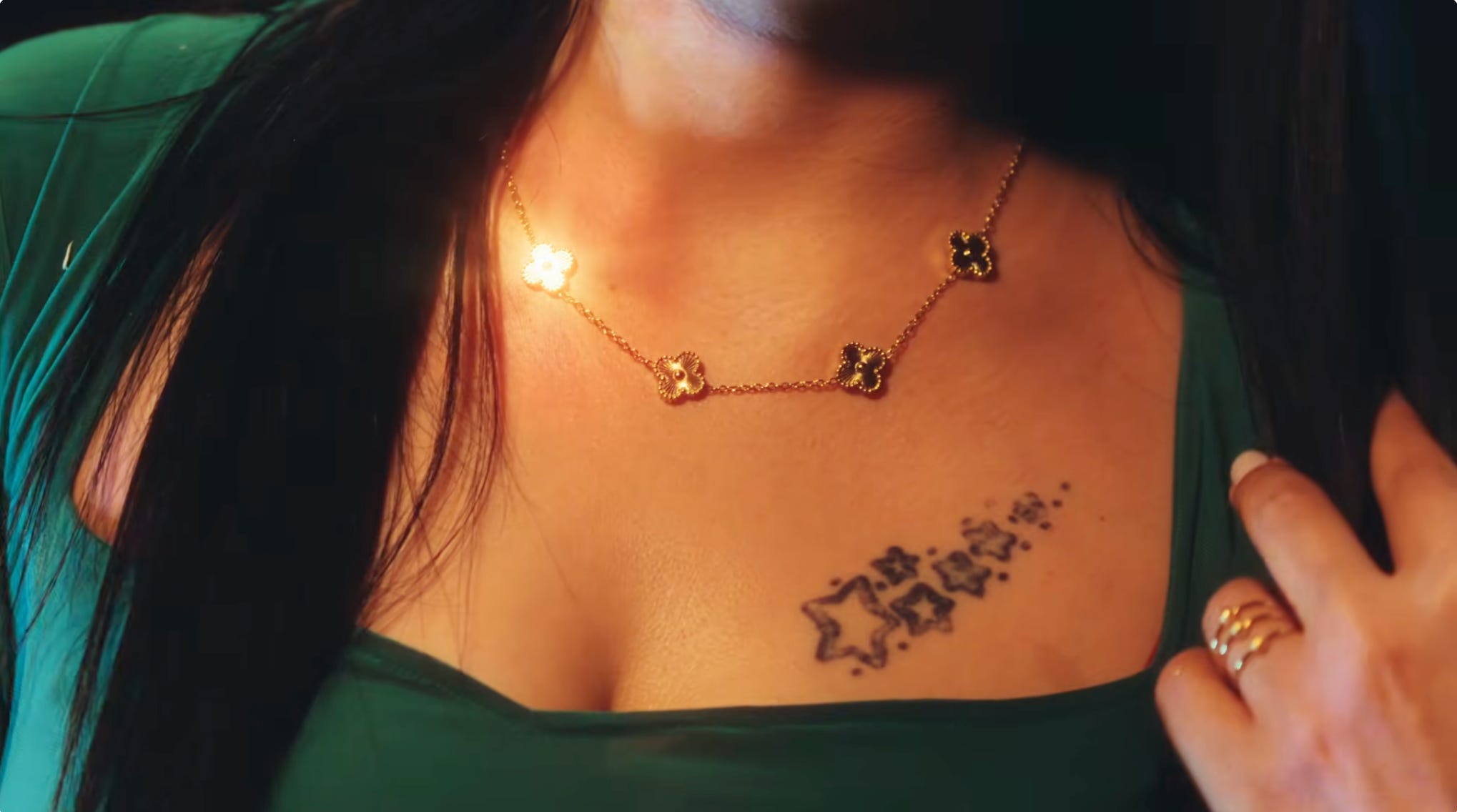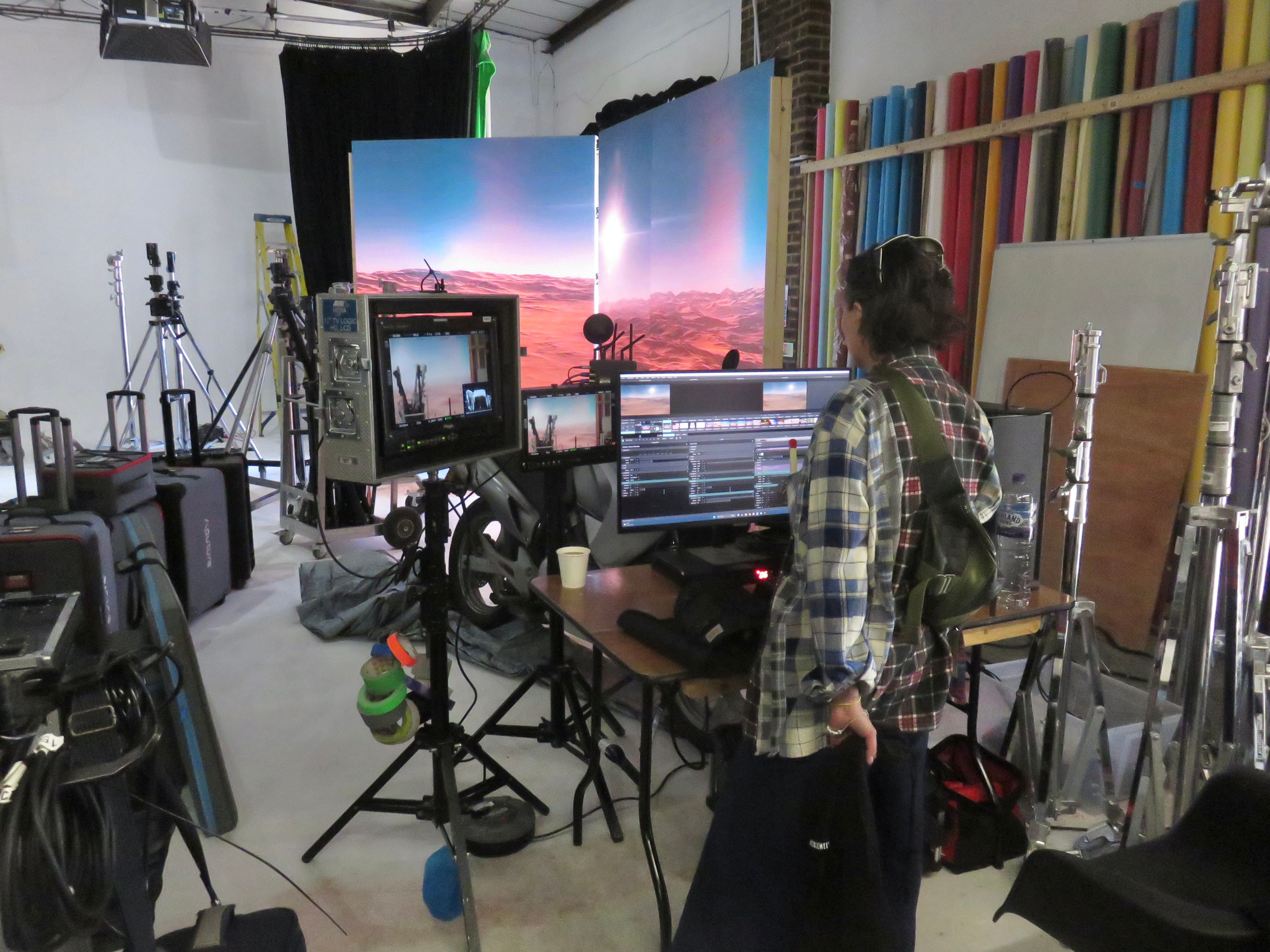


New music from Fatima Al Qadiri is always cause for elation. Today marks the release of “7ilween,” the haunting lead track from her forthcoming four-song EP, 3twi (out October 9, from Hyperdub Records). 7ilween means “pretty young thing” in Kuwaiti-Arabic femme slang, while 3twi means “dirty old man”; the record explores their dialectical dance.
To celebrate, Bidoun Contributing Editor Sophia Al-Maria—who, not coincidentally, directed the mesmerizing video for “7ilween”—conversed with Qadiri, her longtime friend and collaborator, about her ideas and influences this time around: libidinal spillage, accelerationist romance, Iraqi dance music, queer aging, and people-watching.
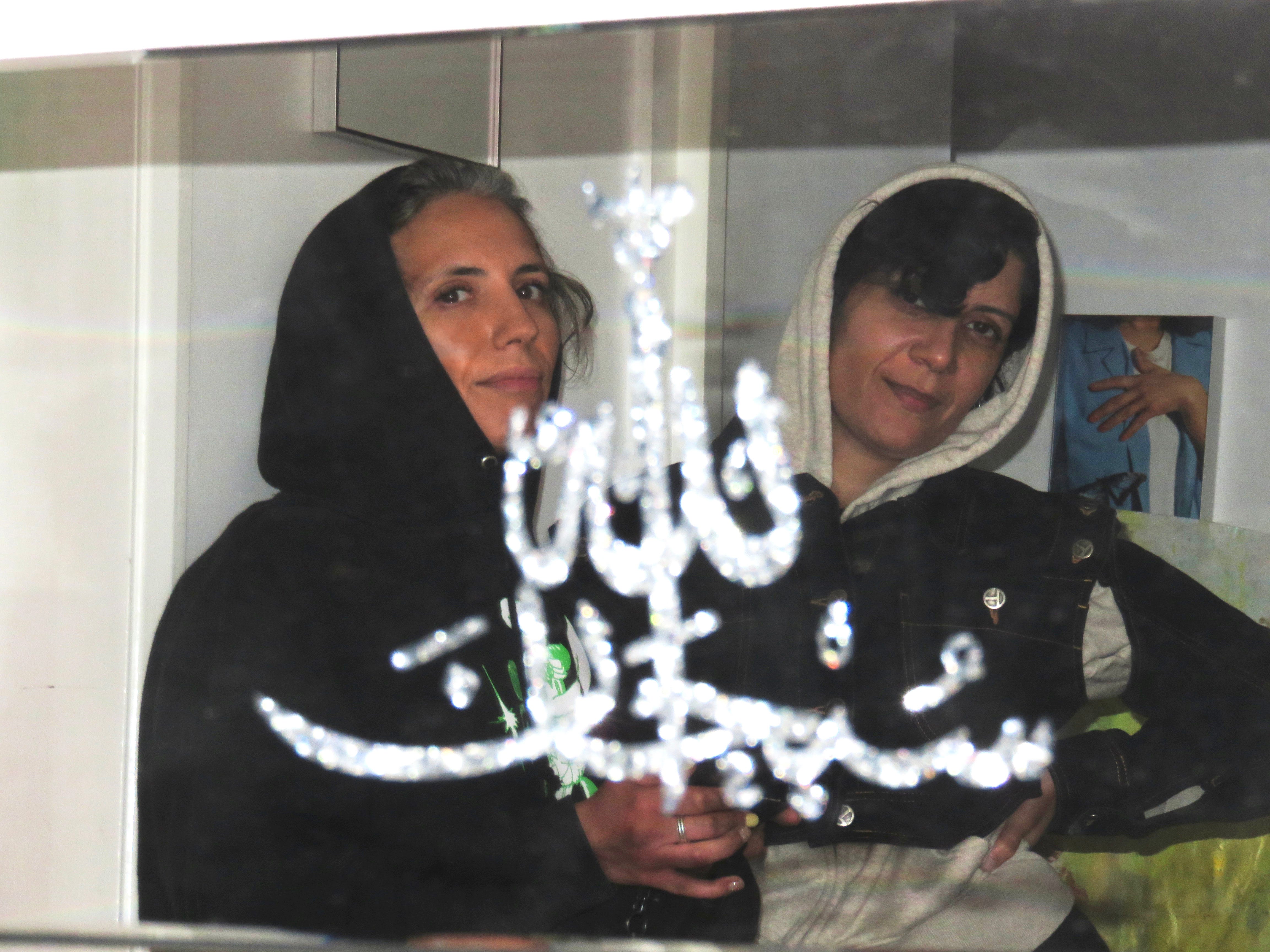
SOPHIA AL-MARIA: Fatima, it’s been a while since you’ve released new music of your own because you’ve been busy making film scores the last few years. I have a suspicion that fans will scream when they hear your 3twi suite, so my first question is… what do you want them to be screaming with? Joy? Fear? Satisfaction?
FATIMA AL QADIRI: There are two faces to this record. One side is coy and the other is, like, demonic. There’s a twisted side. I think Abdullah Al-Mutairi put it very well: it’s like a hunter and prey scenario, and the prey is having a great time playing in the face of the hunter. That’s the vibe.
SAM: That’s such a specific tone, deep and primal. So much of your work is filled with libidinal energy. How do desire and romance figure into your music?
FAQ: I feel like I inherited my mom’s extreme romantic tendencies. You know, when we were kids, she would exclusively play love songs sung by women.
SAM: Always Arabic?
FAQ: They were Arabic and Farsi: Majida El Roumi, Hayedeh, Googoosh, you know? I obviously didn’t understand the Googoosh and Hayedeh tracks, but I could hear the yearning and angst in their voices.
SAM: Do you think we love differently? On this side of the world?
FAQ: I think the acceleration from, “Hello, my name is” to “When are we getting married?” is kind of, like...
SAM: ...7ad addosa [Gulf Arabic expression that approximates “pedal to the metal”]?
FAQ: 7ad addosa. Whereas the idea of courtship in the West is so extremely prolonged compared to our neck of the woods, you know what I mean?
SAM: There are so many songs about longing, most of which are also very long songs. Maybe they’re the length of time it takes to wait...
NEGAR AZIMI: ...until you get an answer?
FAQ: I would say, like, ninety percent of Arabic music is love songs, sung by all the genders. Then it’s five percent nationalist music and five percent Bedouin praise poetry. Those are all the genres, you know? We don’t have any more.
SAM: I think you might be right about that.
FAQ: For instance there’s a radio station in London called Sout al Khaleej, “the Voice of the Gulf,” and it is the most 3twi radio station you could possibly envision. It’s for a specific age of elderly Arab man stranded in London. This is his radio station.
SAM: Oh my god: washed up in a café, people-watching.
FAQ: If 3twi were a place rather than a piece of music, it would definitely be a café with old men people-watching. I feel like there are so many cafés and restaurants in London that cater to that clientele.
SAM: The title of the EP is 3twi. Which comes first for you, the title or the thing?
FAQ: The titles of all my records always emerge after the fact, but they emerge as a way of naming what I’m doing, for sure.
SAM: And the word 3twi means... ?
FAQ: It’s femme slang, what in Kuwaiti is called hetchi hareem.
SAM: Like harem talk.
FAQ: When I asked Gumar, the singer on “Zan Kardeh Ya Nah,” whether he knew what 3twi meant, he was like, “It’s a mangy male alley cat.” When I told him it means “dirty old man,” he gasped! I feel like there’s so much femme slang that’s just not understood by sophisticated straight men. But obviously, gay men immediately know the meaning of the word.
SAM: Well, it’s a privilege to be on the hareemi side, that’s for sure. How did the record come about?
FAQ: At one point I found this Khaleeji Gulfi drum virtual instrument with an Iraqi kit. I had always wanted Iraqi drums but never found a good enough virtual version of them, so when I finally did I was able to create my version of Hacha’—this genre of Iraqi dance music that is both folk and contemporary. Then I layered Khaleeji drums on top of it, and that’s kind of what got me started on the record.
SAM: It’s a really unique sound. The arrhythmic thing that happens with Khaleeji beats—and the Iraqi drum you use, what is it called?
FAQ: A kashaaba. It’s a tiny armpit drum that basically sounds like a digital machine gun.
SAM: What’s special about that kashaaba for you?
FAQ: I’m just obsessed with Hacha’ and have been obsessed with Iraqi music for many, many years—the hair dances, the melodic information, the rhythmic information, the MCs’ style of singing. So being able to pay homage to it is fab. It’s really a love letter to that genre that goes back to my interest in paying homage to different genres by making them my own somehow.
SAM: I am desperately curious to know what genre you might turn yourself to next?
FAQ: I have no idea. Actually, no, that’s a lie. I think the next one is actually so unlike me. It’s jazz.
SAM: That’s a surprise!
FAQ: I know, I know.
SAM: But what is jazz? Like, free jazz or... ?
FAQ: Well, I recorded this really incredible saxophonist named Tapiwa Svosve.
SAM: Amazing person. Amazing musician.
FAQ: Tapiwa slaps. I recorded him for five or six hours, so once I’m done with all my obligations this year, I’ll start to piece together a record from those recordings. It will be... dark jazz. The brooding variety. Like primordial jazz. That’s what it sounds like to me. Jurassic Jazz. It sounds very, very swampy, very “amoeba coming to the surface.”
SAM: That’s so delicious. Like slicked geological plates and palaeosaurses. See, one of the reasons I love talking to you about music is that it’s like synesthesia. Your music often deals with fantasy, too. Can you describe the fantasy of 3twi as a whole?
FAQ: I feel like the story of 3twi is basically kind of a story of queer aging as seen through a pitiful character’s eyes—through a dirty old man who is queer. He’s silent throughout the whole record, we’re just seeing his observations.
SAM: Does he know he’s queer?
FAQ: He knows it. On the first track, “7ilween” (Pretty Young Things), he’s gazing at them while they’re making fun of him and taking his money. As I get older, I feel that there’s something incredibly heartbreaking about being in his position. He’s basically an observer of this world, of the pretty young things, noticing how removed it all is from his reality when he was young. I have a little empathy for his plight, you know? He wants something that he can only buy with money, which is to be in the presence of beauty, and he’s yearning for romance.
SAM: Very bittersweet.
FAQ: It is.
SAM: The record also has a lot of bangers on it that feel very celebratory.
FAQ: They are celebratory. For instance, “Zan Kardeh Ya Nah,” to me, is also from the gaze of an elder gay man, but one who’s having a good time. His mother is asking him, “Did you get married?” He’s dancing, frolicking in the hills, so the implied answer is “no.”
SAM: Like a young goat.
FAQ: Yeah, basically. I mean, when I first started writing this track, it literally sounded like a shepherd dancing with his sheep. And I feel like the images came from the Iranian film The Cow (1969). Are you familiar with that film? Negar, I’m sure you know that film.
NA: It’s the strangely gorgeous story of a farmer who’s in love with his cow.
FAQ: It’s so beautiful and basically, the imagery in my head was really inspired by that film, by how this old man is just so deeply devoted to and in love with his cow. I hadn’t seen Gumar, the vocalist on the track, in a very long time. We sat down in a café, catching up in Kuwait, and he tells me about how every time his grandmother called him—from the age of fourteen onwards—she asked that question: “Did you get married or not?” How does it translate in Farsi?
NA: “Did you make a woman or not?”
FAQ: Did you make a woman or not. I was so inspired by this granny hounding her adolescent grandson to get married, and I just felt that this really needed to be a track. It’s definitely a queer West Asian anthem, you know?
SAM: For real. I thankfully stopped getting asked that once I passed a certain age, but there was a time. My answer was always “Not yet!”
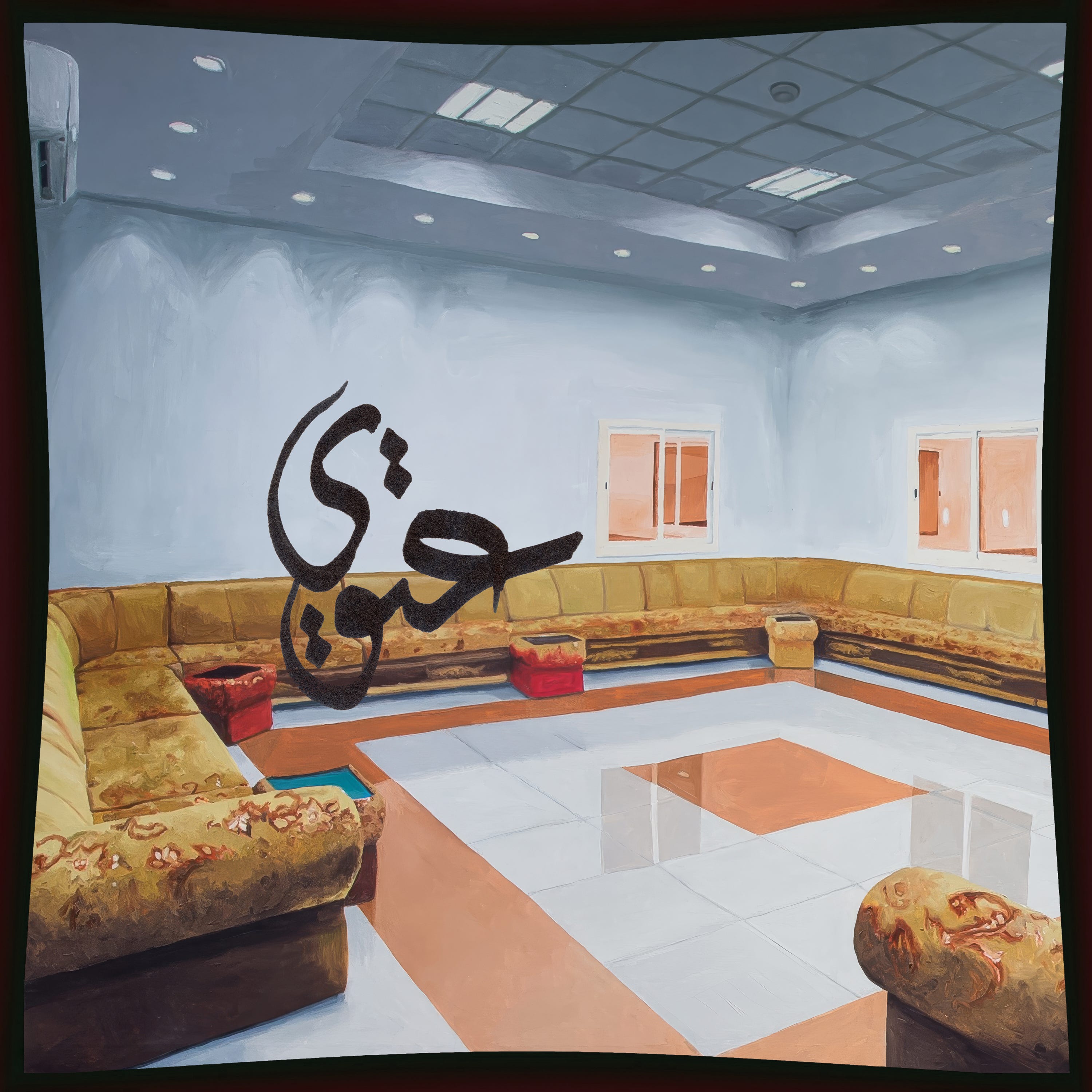
I’m also curious about the cover art, and the painting of the empty majlis on the front. I was imagining the 3twi character sitting there...
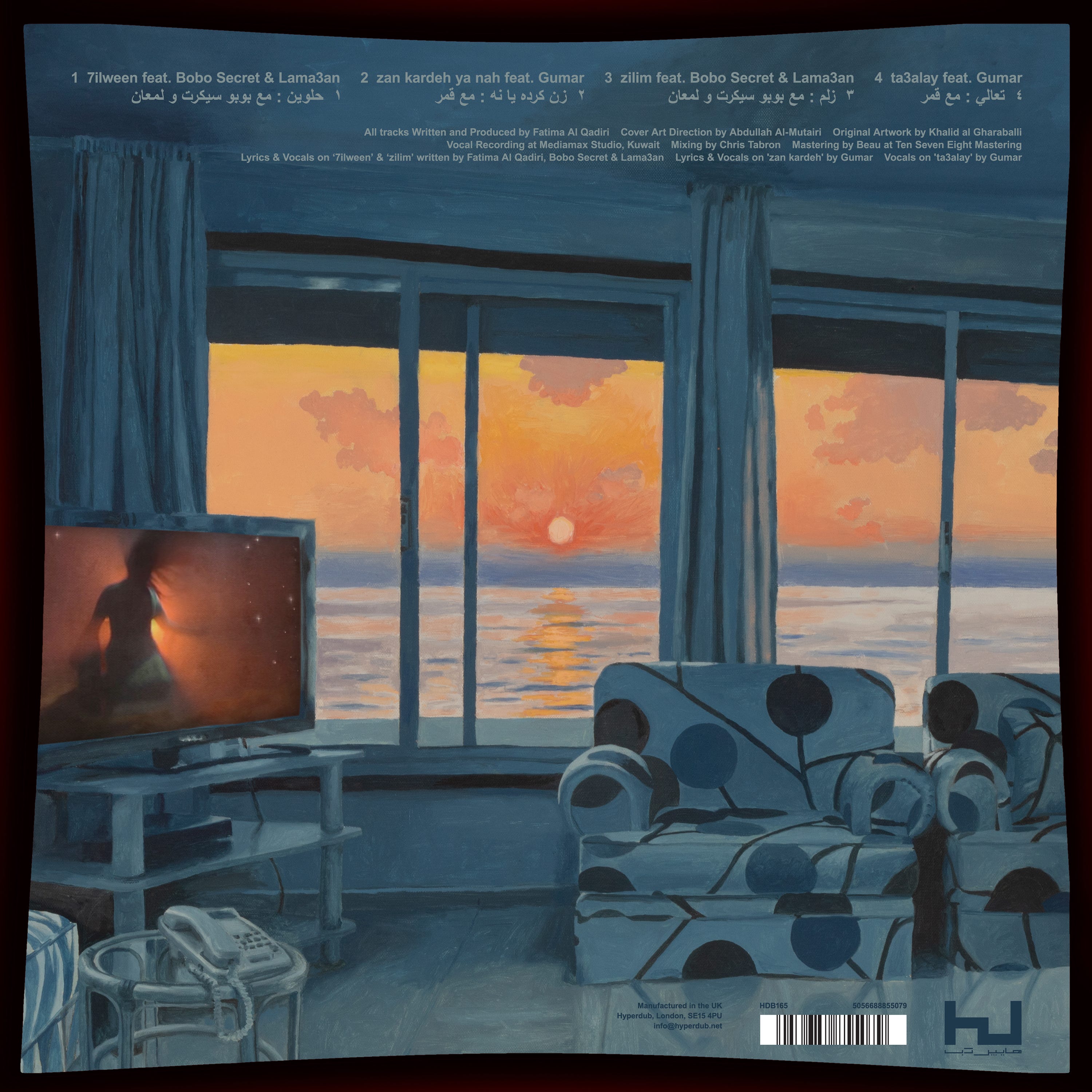
FAQ: Well, this is the thing. The back cover is a painting by Khaled al Gharaballi of a chalet from either the late 80s or the early 90s. In both spaces, the 3twi isn’t physically there, his presence is implied. Any majlis, which we call diwaniya in Kuwait, and also any chalet can be occupied by this character. He’s basically retired, has nothing to do, and is constantly chatting and drinking coffee with his shisha-smoking companions when he’s not seeking the 7ilween.
SAM: The whole EP does feel like a voyeuristic appreciation of beauty. Watching people in a hotel lobby or whatever is very different than being a wallflower who doesn’t leave the majlis and just watches the videos at home. It reminds me of characters in Western European nineteenth-century novels. I often think that there’s a correlation between those novels and the contemporary Gulf.
FAQ: Yes.
SAM: It has to do with the unsaid things about class, or about gender, or even about the expectations for getting married. We are still living in a time of extreme sensitivity where people can be read like a book—not to be judged but to be witnessed.
FAQ: Totally.
SAM: Let’s go through the other two tracks, hear about your inspo. You know, for the completist.
FAQ: For sure. “Zilim,” which is a Levantine word, I think, for “macho man” came from this TikTok video that went semi-viral in Kuwait among a certain set of people. Abdullah introduced me to it. The video is of two dolls. One of them is being harassed, so the other one stands up for her, saying “Hathi. Hathi alzilim!” which means “She! She’s the macho man, her!” I was just like, wow, this is definitely going to be a Butch femme anthem. And there’s a shout-out to the boyat at the beginning of the track—
SAM: —our butch heroes, icons of our generation!
FAQ: And then the last track, “Ta3alay,” is taken from one of my oldest childhood memories of watching this Japanese cartoon Tokimeki Tonight — its Arabic dub was Ranzi Almudhisha (The Amazing Ranzi), and its theme song was sung by a very famous Lebanese vocalist-artist named Ihsan Sadek. The show’s about Ranzi, a beauty who lives in the imagination, and he calls out to her, ta3alay, “Come here... don’t just inhabit my imagination. You’re a beautiful picture, but I want you to come here.” So it has to do with the delusion of desire, the yearning for an illusion. I had Gumar sing on top of it to create a kind of double vocal to emphasize the desire, to double it. And I wrote a completely new instrumental underneath it that is much more melancholic than the original, which is more lighthearted.
SAM: It feels like it really reinforces the general bittersweetness that you’re talking about. Is there anything sadder on the planet than the butch looking back upon her life, wondering what loves could have been? I mean, I was just reading about lesbians and lesbian-like women in medieval Islam. Some of the great poetry comes out of that experience, but usually it speaks to the heat of the moment, not really to looking back upon one’s life. So the album feels like a nice protest against erasure—but maybe I’m over-intellectualizing it.
FAQ: No, it’s interesting. I wonder, because I’m feeling like I’m entering a new era of my life, if I’m starting to think about how my romances will play out in the future? There’s something very vulnerable and... I don’t know. I wouldn’t have been able to make this record as a younger person. I feel like it’s very befitting of where I am right now.
SAM: We all have an 3twi inside.
FAQ: Oh, for sure.
SAM: It’s also to be in the presence of beauty and not have to pay for it.
FAQ: No, no, for sure. And I hope I never do.
SAM: Oh, you’re a man of note.
FAQ: I am a man of note! That’s a cute way of ending the conversation.